


 Prev
Prev
Number of Connections Less Important Than Proximity to Core
A team of researchers led by Dr. Hernan Makse, professor of physics at The City College of New York (CCNY), has shed new light on the way that information and infectious diseases proliferate across complex networks. Writing in "Nature Physics," they report that, contrary to conventional wisdom, persons with the most connections are not necessarily the best spreaders.
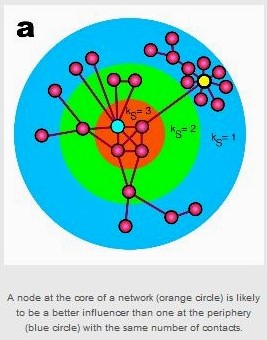 "The important thing is where someone is located in a network," said Professor Makse in an interview. "If someone is in the core, they can spread information more efficiently. The challenge is finding the core."
That kind of information could help marketers and public relations practitioners conduct more effective of social media and social marketing campaigns. It could also help epidemiologists target resources to reduce the spread of infectious diseases.
To identify the core, Professor Makse and colleagues used a technique call k-shell decomposition. In this process, network nodes with just one link are removed until no single-link nodes remain. The remaining nodes are assigned a k-shell value of one. The process is repeated with higher k-shell values assigned to remaining nodes after each round of cuts. Those nodes that cannot be reduced to a single link are identified as the core of the network and have the highest k-shell values.
Read more.