


5 Must-Know Python Concepts for AI Engineers
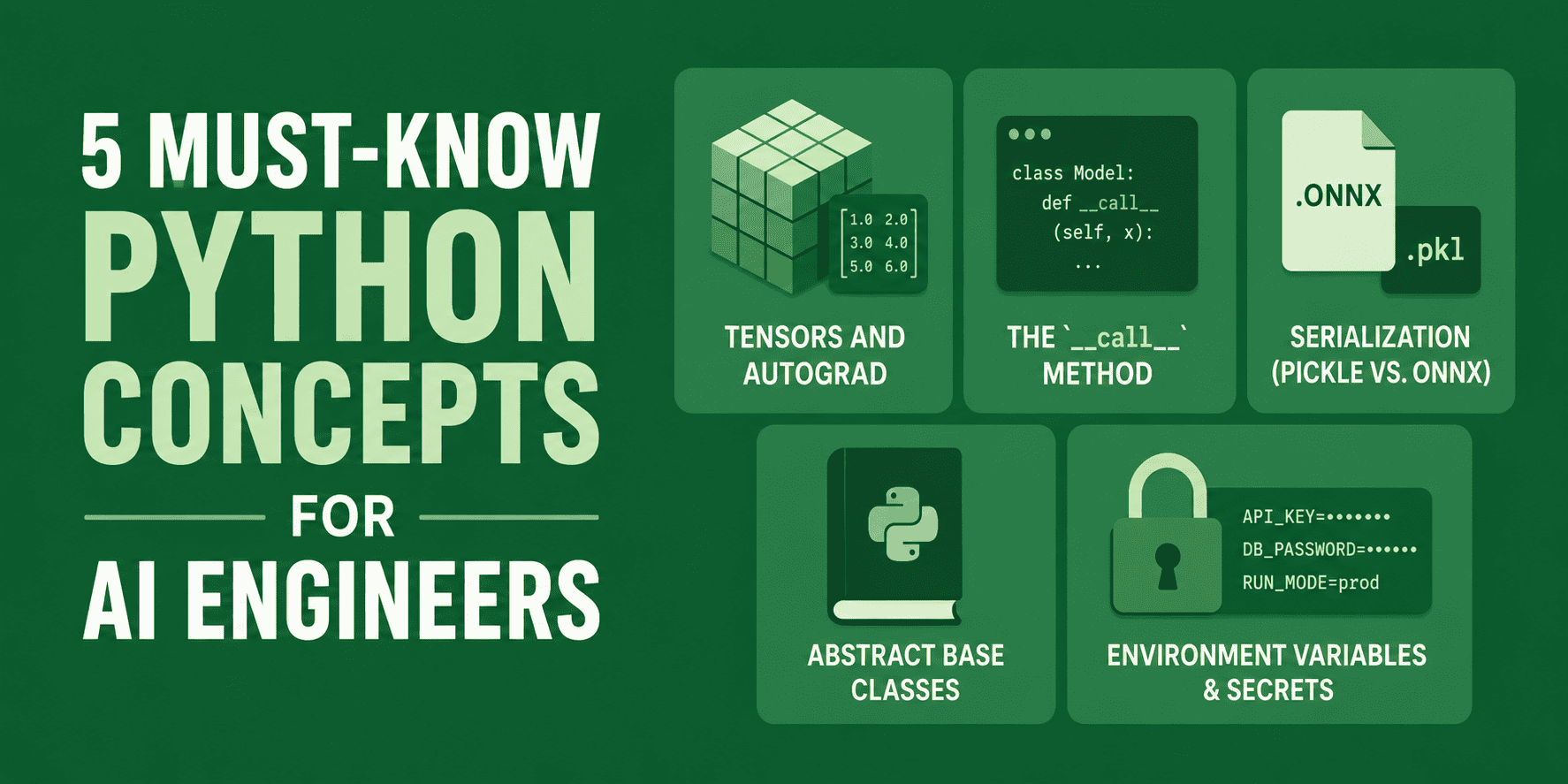
In this article, we will explore five critical Python concepts that every AI engineer must know to build scalable, secure, and robust systems.
# Introduction
The role of an AI engineer has now definitively split from traditional data science. If the job title is interested in you, it is no longer enough to know how to train a model; you must know how deep learning frameworks operate under the hood, how to design modular and robust pipelines, and how to safely serialize and deploy models at scale. And guess what? Python plays a central role in AI engineering just as it has historically played — and currently plays! — in data science.
To build production-grade AI applications and deep learning architectures, you need to master the fundamental Python concepts that modern approaches rely on. In this article, we will explore five critical Python concepts, ranging from PyTorch's computational graph mechanisms to secure environment configuration, that every AI engineer must know to build scalable, secure, and robust systems.
# 1. Tensors and Autograd
Deep learning is fundamentally about optimizing weights via gradient descent, which requires computing partial derivatives, or gradients, across complex computational graphs. While you could manually write backpropagation equations for a simple network, doing so for architectures with millions of parameters is mathematically and computationally intractable.
Modern deep learning frameworks like PyTorch and TensorFlow automate this via autograd, or automatic differentiation. When a tensor is initialized with requires_grad=True, PyTorch dynamically tracks all operations performed on it to build a directed acyclic graph (DAG) of computations. Calling .backward() on a scalar loss traverses this DAG in reverse, applying the chain rule automatically to compute gradients.
// The Clunky Way
Suppose we want to calculate the gradient of a simple loss function $L = (wx + b - y)^2$ with respect to weight $w$ and bias $b$. Calculating this manually is verbose, rigid, and prone to analytical derivation mistakes:
# Inputs and target
x, y = 2.0, 5.0

# Initial weights and bias
w, b = 0.5, 0.1

# 1. Forward pass
pred = w * x + b
loss = (pred - y) ** 2

# 2. Manual backpropagation (calculating partial derivatives analytically)
# dLoss/dpred = 2 * (pred - y)
# dpred/dw = x
# dpred/db = 1
dloss_dpred = 2 * (pred - y)
dw = dloss_dpred * x
db = dloss_dpred * 1

print(f"Manual Gradients -> dw: {dw:.4f}, db: {db:.4f}")
// The Pythonic Way
Here is the production standard. By declaring tensors with requires_grad=True, we let PyTorch construct the computational graph and calculate the exact mathematical derivatives automatically:
import torch

# Inputs and target
x = torch.tensor(2.0)
y = torch.tensor(5.0)

# PyTorch tracks operations on these weights to compute derivatives
w = torch.tensor(0.5, requires_grad=True)
b = torch.tensor(0.1, requires_grad=True)

# 1. Forward pass
pred = w * x + b
loss = (pred - y) ** 2

# 2. Automated backpropagation
loss.backward()

# Access computed gradients directly from the tensor attributes
print(f"Autograd Gradients -> dw: {w.grad.item():.4f}, db: {b.grad.item():.4f}")
Output:
Manual Gradients -> dw: -15.6000, db: -7.8000
Autograd Gradients -> dw: -15.6000, db: -7.8000
Autograd dynamically tracks every mathematical node (like addition or exponentiation) as a C++ object. This dynamic graph generation allows PyTorch to easily handle complex architectural features like dynamic loops, conditional execution, and recursive networks, abstracting away the mathematical complexity of backpropagation.
# 2. The __call__ Method
If you inspect PyTorch model architectures, you will notice that layers and models are never invoked by explicitly calling a .forward() or .compute() method. Instead, model and layer instances are treated like standard Python functions and called directly e.g. model(inputs).
This clean syntax is made possible by Python's __call__ dunder method. Implementing __call__ inside a class permits its instances to behave as callable functions. Importantly, PyTorch's base nn.Module implements __call__ to execute system-level setup (such as registering and executing pre-forward and post-forward hooks) before executing the user-defined forward() logic.
// The Clunky Way
Creating custom layer configurations where clients must call specific method names explicitly limits composition and breaks compatibility with standard deep learning pipelines.
class CustomLinearLayer:
    def __init__(self, weight: float, bias: float):
        self.weight = weight
        self.bias = bias

    def compute_forward_pass(self, x: float) -> float:
        # Rigid, explicitly named execution method
        return x * self.weight + self.bias

# Instantiation and execution
layer = CustomLinearLayer(weight=0.5, bias=0.1)
output = layer.compute_forward_pass(2.0)
print(f"Output: {output}")
// The Pythonic Way
By implementing the __call__ method, we enable our class instances to be called directly. We can also simulate how frameworks like PyTorch execute auxiliary pipeline hooks seamlessly.
class PythonicLinearLayer:
    def __init__(self, weight: float, bias: float):
        self.weight = weight
        self.bias = bias
        self._hooks = []

    def register_hook(self, hook_func):
        self._hooks.append(hook_func)

    def __call__(self, x: float) -> float:
        # Run registered pre-processing or logging hooks
        for hook in self._hooks:
            hook(x)
        # Run the actual forward calculations
        return self.forward(x)

    def forward(self, x: float) -> float:
        return x * self.weight + self.bias

# Instantiation
layer = PythonicLinearLayer(weight=0.5, bias=0.1)

# Register a dynamic telemetry hook
layer.register_hook(lambda x: print(f"[Telemetry] Input value passed: {x}"))

# Execute the layer as a standard function
output = layer(2.0)
print(f"Result: {output}")
Sample output:
[Telemetry] Input value passed: 2.0
Result: 1.1
In production AI systems, always call the instance directly (model(inputs)) rather than calling model.forward(inputs). Directly invoking .forward() bypasses the __call__ wrapper entirely, leaving hooks (such as activation tracking, gradient clipping, or device synchronization hooks) completely unexecuted, which can lead to silent errors.
# 3. Serialization: Pickle vs. ONNX
Training an AI model is expensive. Saving the model for deployment should be fast and reliable. For years, Python developers relied on the standard pickle module to serialize objects. However, in production AI engineering, pickle is considered a significant anti-pattern. This is because pickle is language-locked (it only works in Python), tightly coupled to the exact file hierarchy/class structure of the training codebase, and highly insecure (loading a pickle file can trigger arbitrary code execution, leaving servers vulnerable to remote exploits).
The production standard for cross-platform model deployment is Open Neural Network Exchange, or ONNX. ONNX compiles the neural network into a static, language-agnostic computation graph that can be executed at native C++ speeds using runtimes like ONNX Runtime, completely independent of Python.
// The Clunky Way
Saving a PyTorch model state using pickle locks deployment to Python servers and exposes environments to security vulnerabilities.
import torch
import torch.nn as nn
import pickle

class SimpleMLP(nn.Module):
    def __init__(self):
        super().__init__()
        self.fc = nn.Linear(10, 2)
    def forward(self, x):
        return self.fc(x)

model = SimpleMLP()

# Dumping the entire model using pickle
with open("model.pkl", "wb") as f:
    pickle.dump(model, f)
⚠️ WARNING: Loading untrusted pickle files can execute malicious OS commands!
// The Production Way
The better option is to trace the model's graph with a sample input, compile it into an ONNX graph, and save it as a highly portable, platform-independent binary file.
import torch
import torch.nn as nn

class SimpleMLP(nn.Module):
    def __init__(self):
        super().__init__()
        self.fc = nn.Linear(10, 2)
    def forward(self, x):
        return self.fc(x)

model = SimpleMLP()

# Set to evaluation mode before exporting
model.eval()

# ONNX requires a dummy input to trace the operations and execution paths
dummy_input = torch.randn(1, 10)

# Export the dynamic model structure to a standardized ONNX graph
torch.onnx.export(
    model,
    dummy_input,
    "model.onnx",
    export_params=True,        # Store trained parameter weights inside the file
    opset_version=15,          # Select the ONNX operator set version
    input_names=["input"],     # Define entry input node names
    output_names=["output"],   # Define exit output node names
    dynamic_axes={"input": {0: "batch_size"}, "output": {0: "batch_size"}} # Allow variable batch size
)

print("Model compiled and exported to 'model.onnx' successfully!")
Sample output:
Model compiled and exported to 'model.onnx' successfully!
Exporting to ONNX breaks the coupling to your Python training code. The tradeoff is that the resulting model.onnx file can be loaded natively in C++, Rust, Java, or Javascript web environments. Additionally, high-performance execution engines like NVIDIA's TensorRT or Apple's CoreML can ingest ONNX models directly to optimize runtime speed on target hardware.
# 4. Abstract Base Classes
Modern AI systems depend heavily on modular infrastructure. You might swap out an OpenAI LLM for a local Hugging Face model, or transition from a CSV data loader to an active database stream. If team members write custom classes without adhering to a interface, the pipeline will crash at runtime due to missing or mismatched methods.
To establish reliable interfaces, Python provides abstract base classes (ABCs) via the abc module. An ABC acts as an explicit blueprint. By marking methods with the @abstractmethod decorator, you guarantee that any subclass must implement these methods. If it doesn't, Python will refuse to instantiate the class, catching design errors at startup.
// The Clunky Way
Using brittle duck typing classes can lead to naive parent classes that raise NotImplementedError. Subclasses can be instantiated successfully even if they are incomplete, deferring runtime failures to when the application is already processing requests.
class BrittlePredictor:
    def predict(self, x):
        # Brittle fallback check
        raise NotImplementedError("Subclasses must implement this method!")

class IncompletePredictor(BrittlePredictor):
    # Developer forgot to implement predict
    pass

# Instantiation succeeds without warnings
predictor = IncompletePredictor()

# Crash occurs late in production when we attempt execution
try:
    predictor.predict([1, 2, 3])
except NotImplementedError as e:
    print(f"Runtime Crash: {e}")
// The Pythonic Way
The better way is to enforce interfaces using Python's abc module. This ensures that interface compliance is enforced the moment you attempt to instantiate the subclass, guaranteeing structural safety across components.
from abc import ABC, abstractmethod

class CustomModelInterface(ABC):
    @abstractmethod
    def predict(self, x: list) -> list:
        """Enforce standard prediction signature."""
        pass

    @abstractmethod
    def get_model_metadata(self) -> dict:
        """Enforce metadata configuration schema."""
        pass

class RobustPredictor(CustomModelInterface):
    # Developer implements predict but forgets get_model_metadata
    def predict(self, x: list) -> list:
        return [val * 2 for val in x]

# Instantiating the incomplete subclass triggers an immediate TypeError!
try:
    predictor = RobustPredictor()
except TypeError as e:
    print(f"Instantiation blocked: {e}")
Output:
Runtime Crash: Subclasses must implement this method!
Instantiation blocked: Can't instantiate abstract class RobustPredictor with abstract method get_model_metadata
Using ABCs is critical when building complex LLM agents, RAG pipelines, or custom feature extractors. By formalizing agreements between components, you can write robust integration tests and ensure clean, predictable swaps of infrastructure elements.
# 5. Environment Variables & Secrets
Contemporary AI engineering is highly dependent on cloud-hosted external APIs. Connecting to services like OpenAI, Anthropic, HuggingFace, Pinecone, or AWS requires secure management of highly sensitive API tokens and credentials.
Hardcoding these keys directly into your Python scripts is a massive security hazard. It can lead to accidental credential leaks when code is pushed to public repositories. In accordance with the cloud-native Twelve-Factor App methodology, secrets must always be kept strictly separate from the codebase, isolated in system environment variables, and loaded dynamically using python-dotenv.
// The Clunky Way
Storing active API keys directly in the script exposes sensitive assets to anyone who has access to the codebase.
# CRITICAL SECURITY RISK: Hardcoding credentials directly in the script
OPENAI_API_KEY = "sk-proj-5f9j3h8d2j8dfnsls02ksl83k..."

def initialize_client():
    # If this file is committed to GitHub, the key is permanently compromised
    return f"Client initialized with key ending in: ...{OPENAI_API_KEY[-5:]}"

print(initialize_client())
// The Secure Way
It's best to decoupled the configuration via python-dotenv. First, create a .env file in your project's root directory (and immediately add .env to your .gitignore file to prevent it from ever being tracked).
In your .env file:
OPENAI_API_KEY=sk-proj-5f9j3h8d2j8dfnsls02ksl83k...
PINECONE_ENV=us-east-1
Then, load the environment variables dynamically at execution time using the python-dotenv package:
import os
from dotenv import load_dotenv

# Load all configurations from the local .env file into the system environment
load_dotenv()

def initialize_secure_client():
    # Fetch key from isolated system environment
    api_key = os.getenv("OPENAI_API_KEY")

    if not api_key:
        raise ValueError("Critical Security Error: OPENAI_API_KEY is not set in environment!")

    return f"Client initialized safely with key ending in: ...{api_key[-5:]}"

print(initialize_secure_client())
Output:
Client initialized safely with key ending in: ...sl83k
Using python-dotenv allows your application to remain completely environment-agnostic. When running locally, it reads keys from the .env file. When running in a production container (like Docker) or serverless cloud framework (like AWS Lambda or GCP Cloud Run), the local file is ignored, and Python automatically fetches the credentials natively set in the cloud container's system environment.
# Wrapping Up
Developing for AI requires a blend of data science intuition and sound software engineering practices. By mastering these five fundamental concepts, you transition from writing simple scripts to building production-grade AI systems.
By understanding PyTorch's dynamic computational DAGs, you gain deep control over custom architectures. Respecting the dunder __call__ method allows you to integrate cleanly with framework ecosystems. Shifting from fragile, language-locked pickle files to ONNX models ensures secure, lightning-fast cross-platform inference. Implementing abstract base classes enforces modular interface boundaries, while decoupling API configurations via system environment variables protects your pipelines from critical security leaks.
Treat your model pipelines as robust software products. When you prioritize performance, security, and interface safety, your AI applications will run faster, fail less, and scale smoothly to the cloud.
Matthew Mayo (@mattmayo13) holds a master's degree in computer science and a graduate diploma in data mining. As managing editor of KDnuggets & Statology, and contributing editor at Machine Learning Mastery, Matthew aims to make complex data science concepts accessible. His professional interests include natural language processing, language models, machine learning algorithms, and exploring emerging AI. He is driven by a mission to democratize knowledge in the data science community. Matthew has been coding since he was 6 years old.