


5 Useful Things to Do with Google’s Antigravity Besides Coding
Antigravity is sitting on a stack of capabilities, many of which have very little to do with writing functions.
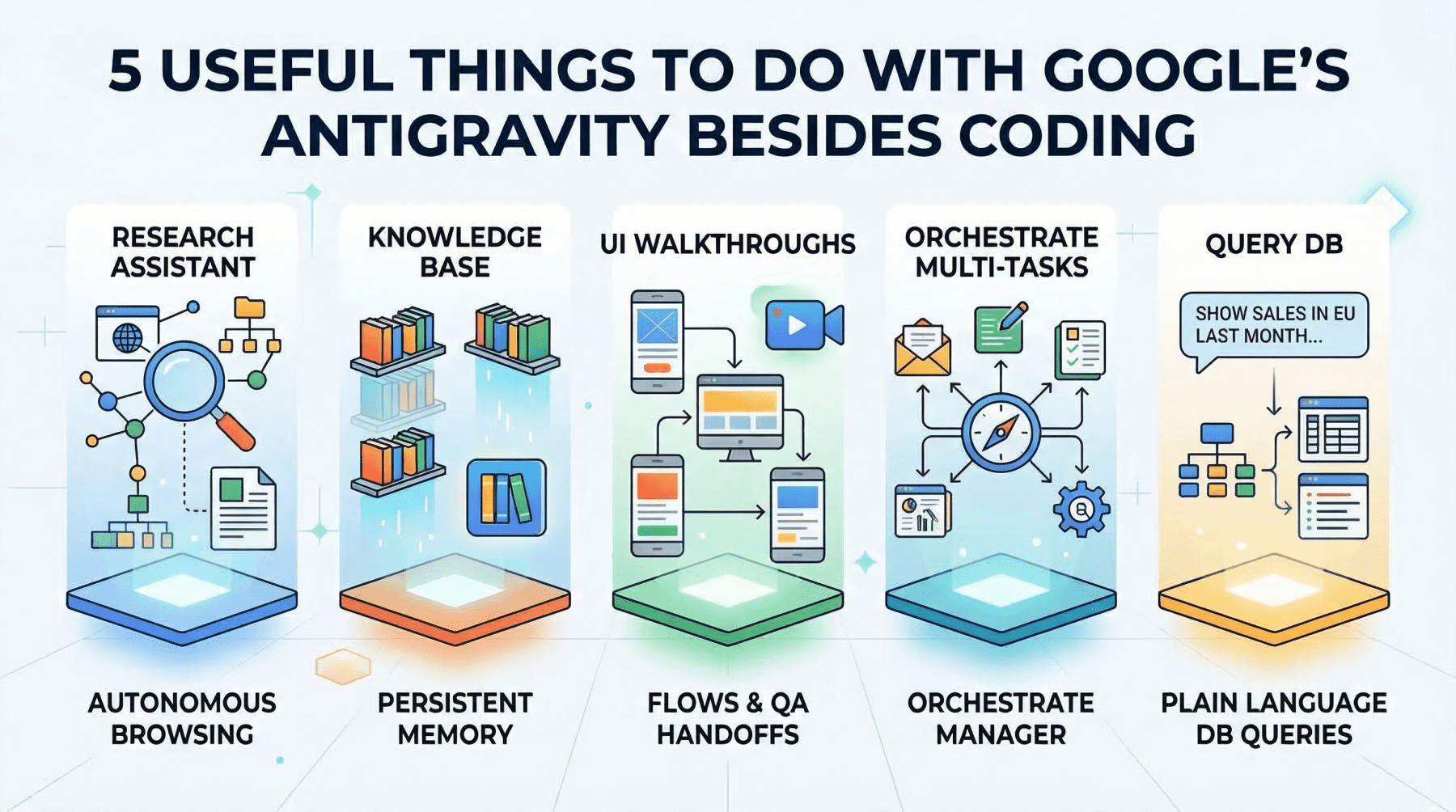
Image by Editor
# Introduction
Most people who downloaded Antigravity ran one agent to scaffold an app, watched Gemini 3 do its thing, and immediately started thinking about all the code they'd never have to write again. Totally understandable.
But Antigravity is sitting on a stack of capabilities, many of which have very little to do with writing functions. It's got a browser that sees and navigates your screen, a memory system that actually persists across sessions, and an agent framework that can juggle multiple tasks simultaneously. Once you clock that, the use cases get a lot more interesting than your next pull request.
# 1. Use It as a Research Assistant
If you've ever tried to do competitive research properly, you know the routine. You open fifteen tabs, forget which one had the pricing breakdown, write notes that make no sense three days later, and produce something half-finished.
Antigravity's browser agent handles this loop without you managing it. You describe what you're after — competitors' announcements, pricing pages, recent product updates — and it navigates the web autonomously, pulling together a structured Artifact you can actually work with.
The browser integration here is deeper than it sounds. Because Google built Antigravity around Chrome, the agent sees pages the way a human does: scrolling, clicking, and reading rendered content rather than parsing raw HTML. You get a coherent, commentable output at the end of it. For anyone who does recurring market research as part of their job, this alone is worth the install.
The agent can also structure its findings by category, source, or recency if you ask it to. Instead of a wall of text, you get something organized and actually referenceable. That's the kind of output that would normally require writing a research brief and then waiting for someone else to execute it.
# 2. Build a Knowledge Base That Doesn't Evaporate
One of Antigravity's design principles is that it treats learning as a persistent feature — rather than a session-by-session reset. The platform lets agents save context, patterns, and reference material to a shared knowledge base that carries across sessions and improves as you use it.
The interesting thing is that this system doesn't care whether you're feeding it code snippets or company documentation. You can load it with style guides, research notes, internal standard operating procedures (SOPs), or even create flashcards using Coursebox for any reference material you need to stop re-explaining from scratch. For anyone who's pasted the same context into every new tool they try, this is the feature that addresses the actual problem.
It's structured memory with a purpose, and it doesn't get wiped when you close the window. Over time, the agents working within that knowledge base get more accurate and more context-aware, because they're drawing on a history of your work rather than starting fresh every single session.
# 3. Generate UI Walkthroughs Without the Manual Work
Product managers, user experience (UX) researchers, and anyone who's had to document a user interface (UI) flow by hand will want to pay attention here. Antigravity's browser agent can navigate a live application, step through a workflow, capture screenshots at each stage, and compile the whole thing into a walkthrough Artifact. It records video of itself doing it. You point it at a URL, describe the flow, and let it run.
What you end up with is a timestamped, visual, commentable user journey that took the agent a few minutes to produce. That kind of deliverable would normally cost a day or two of consistent work. The output reflects the exact state of the interface at the time the agent ran through it, which makes it genuinely reliable for quality assurance (QA) handoffs or stakeholder reviews.
# 4. Orchestrate Multiple Tasks at Once
The Agent Manager gives you a mission-control interface for running multiple agents in parallel across different workspaces. Each agent gets its own task, its own context, and its own set of Artifacts to produce. You interact asynchronously, checking outputs when they're ready rather than watching every step play out in real time.
The framing in Antigravity's own documentation is developer-centric, but there's nothing in the mechanics that limits it to code. Running a content audit, a market research task, and a database exploration simultaneously is entirely viable. Each agent works independently in its own lane, and you're operating at the level of assigning briefs rather than executing work yourself.
It's one of those features that sounds marginal until you've actually had three things going at once. The reduction in context-switching alone makes it worth exploring, especially if you regularly juggle work across different kinds of sources or formats.
# 5. Query Your Databases in Plain Language
Antigravity ships with native Model Context Protocol (MCP) server support, meaning it can connect to databases like BigQuery, AlloyDB, and Spanner through a UI-driven setup. The agent gains access to your schema and can query it, describe it, and reason over it in natural language. You add your project details, authenticate through identity and access management (IAM) credentials, and the agent handles the translation between your question and what the database needs to produce.
For analysts or operations people who need regular answers from large datasets without dropping into a SQL client every time, this is quietly powerful. There's no configuration file to wrestle with, your credentials stay out of the chat window, and you describe what you want in plain terms. The agent writes the query; you get the answer.
It's also worth noting that the connection setup is genuinely UI-driven. There's a form, you fill it in, and the agent is connected. No YAML files, no copy-pasting connection strings, and no debugging a setup that worked yesterday and broke today for no clear reason.
# Concluding Thoughts
Antigravity launched as a coding tool because that's where the benchmarks are and that's what makes a clean product announcement. But the actual architecture covers autonomous browser agents, persistent knowledge bases, parallel task orchestration, and native database connectivity.
Very little of that is exclusively about writing functions. It's an agent platform that happens to ship with a polished integrated development environment (IDE). The non-coding use cases are already built in; they just didn't get a dedicated slide in the keynote. Spend some time in the Manager view and the Artifacts system, and you'll start wondering why you'd limit it to code at all.
Nahla Davies is a software developer and tech writer. Before devoting her work full time to technical writing, she managed—among other intriguing things—to serve as a lead programmer at an Inc. 5,000 experiential branding organization whose clients include Samsung, Time Warner, Netflix, and Sony.