


Self-Hosted LLMs in the Real World: Limits, Workarounds, and Hard Lessons
This article is about what actually happens when you take self-hosted LLMs seriously: not the benchmarks, not the hype, but the real operational friction most tutorials skip entirely.
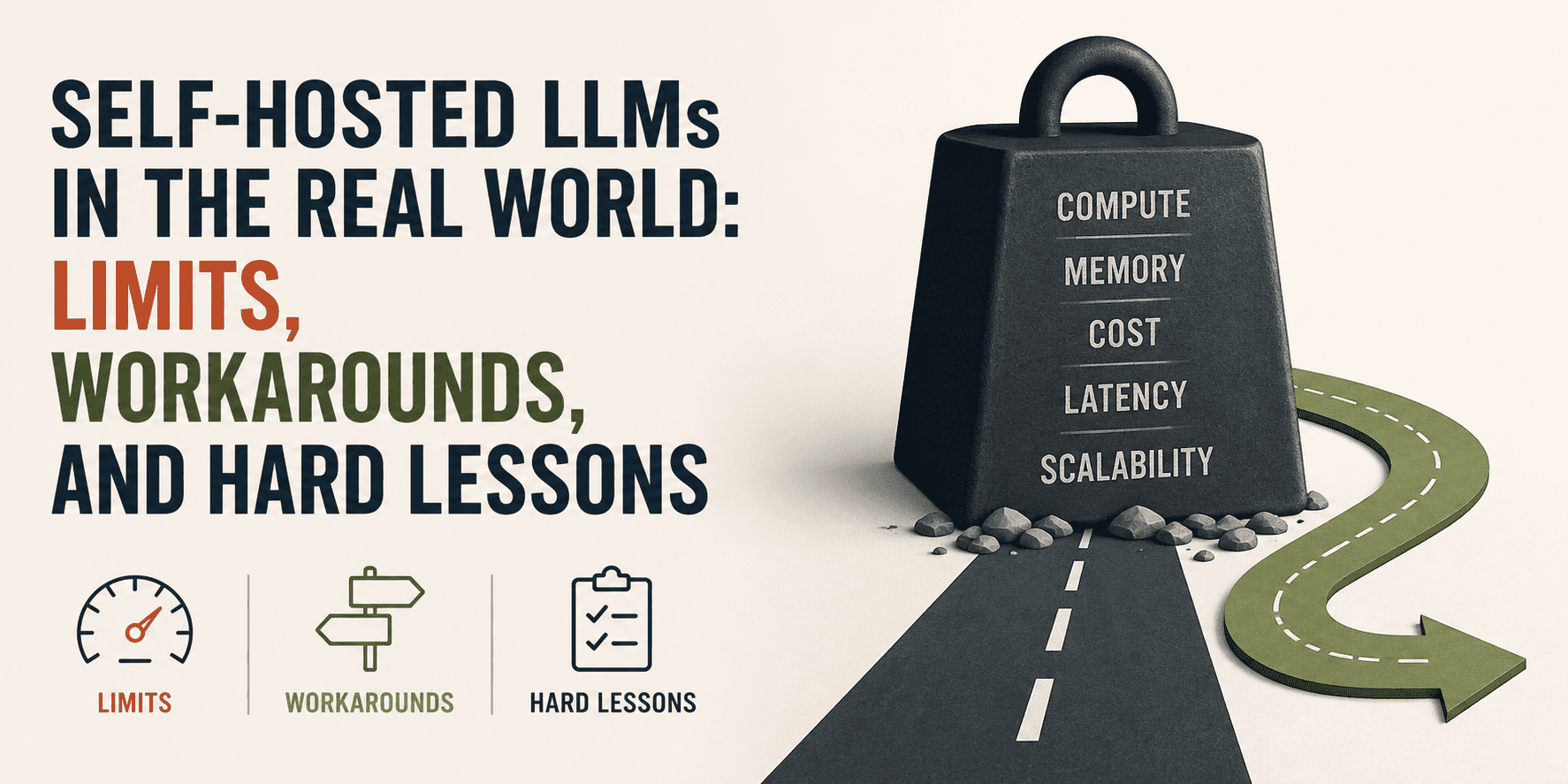
Image by Editor
# The Self-Hosted LLM Problem(s)
"Run your own large language model (LLM)" is the "just start your own business" of 2026. Sounds like a dream: no API costs, no data leaving your servers, full control over the model. Then you actually do it, and reality starts showing up uninvited. The GPU runs out of memory mid-inference. The model hallucinates worse than the hosted version. Latency is embarrassing. Somehow, you've spent three weekends on something that still can't reliably answer basic questions.
This article is about what actually happens when you take self-hosted LLMs seriously: not the benchmarks, not the hype, but the real operational friction most tutorials skip entirely.
# The Hardware Reality Check
Most tutorials casually assume you have a beefy GPU lying around. The truth is that running a 7B parameter model comfortably requires at least 16GB of VRAM, and once you push toward 13B or 70B territory, you're either looking at multi-GPU setups or significant quality-for-speed trade-offs through quantization. Cloud GPUs help, but then you're back to paying per-token in a roundabout way.
The gap between "it runs" and "it runs well" is wider than most people expect. And if you're targeting anything production-adjacent, "it runs" is a terrible place to stop. Infrastructure decisions made early in a self-hosting project have a way of compounding, and swapping them out later is painful.
# Quantization: Saving Grace or Compromise?
Quantization is the most common workaround for hardware constraints, and it's worth understanding what you're actually trading. When you reduce a model from FP16 to INT4, you're compressing the weight representation significantly. The model becomes faster and smaller, but the precision of its internal calculations drops in ways that aren't always obvious upfront.
For general-purpose chat or summarization, lower quantization is often fine. Where it starts to sting is in reasoning tasks, structured output generation, and anything requiring careful instruction-following. A model that handles JSON output reliably in FP16 might start producing broken schemas at Q4.
There's no universal answer, but the workaround is mostly empirical: test your specific use case across quantization levels before committing. Patterns usually emerge quickly once you run enough prompts through both versions.
# Context Windows and Memory: The Invisible Ceiling
One thing that catches people off guard is how fast context windows fill up in real workflows, especially when you have to measure it while using Ollama. A 4K context window sounds fine until you're building a retrieval-augmented generation (RAG) pipeline and suddenly you're injecting a system prompt, retrieved chunks, conversation history, and the user's actual question all at once. That window disappears faster than expected.
Longer context models exist, but running a 32K context window at full attention is computationally expensive. Memory usage scales roughly quadratically with context length under standard attention, which means doubling your context window can more than quadruple your memory requirements.
The practical solutions involve chunking aggressively, trimming conversation history, and being very selective about what goes into the context at all. It's less elegant than having unlimited memory, but it forces a kind of prompt discipline that often improves output quality anyway.
# Latency Is the Feedback Loop Killer
Self-hosted models are often slower than their API counterparts, and this matters more than people initially assume. When inference takes 10 to 15 seconds for a modest response, the development loop slows down noticeably. Testing prompts, iterating on output formats, debugging chains — everything gets padded with waiting.
Streaming responses help the user-facing experience, but they don't reduce total time to completion. For background or batch tasks, latency is less critical. For anything interactive, it becomes a real usability problem. The honest workaround is investment: better hardware, optimized serving frameworks like vLLM or Ollama with proper configuration, or batching requests where the workflow allows it. Some of this is simply the cost of owning the stack.
# Prompt Behavior Drifts Between Models
Here's something that trips up almost everyone switching from hosted to self-hosted: prompt templates matter enormously, and they're model-specific. A system prompt that works perfectly with a hosted frontier model might produce incoherent output from a Mistral or LLaMA fine-tune. The models aren't broken; they're trained on different formats and they respond accordingly.
Every model family has its own expected instruction structure. LLaMA models trained with the Alpaca format expect one pattern, chat-tuned models expect another, and if you're using the wrong template, you're getting the model's confused attempt to respond to malformed input rather than a genuine failure of capability. Most serving frameworks handle this automatically, but it's worth verifying manually. If outputs feel weirdly off or inconsistent, the prompt template is the first thing to check.
# Fine-Tuning Sounds Easy Until It Isn't
At some point, most self-hosters consider fine-tuning. The base model handles the general case fine, but there's a specific domain, tone, or task structure that would genuinely benefit from a model trained on your data. It makes sense in theory. You wouldn't use the same model for financial analytics as you would for coding three.js animations, right? Of course not.
Hence, I believe that the future isn't going to be Google suddenly releasing an Opus 4.6-like model that can run on a 40-series NVIDIA card. Instead, we're probably going to see models built for specific niches, tasks, and applications — resulting in fewer parameters and better resource allocation.
In practice, fine-tuning even with LoRA or QLoRA requires clean and well-formatted training data, meaningful compute, careful hyperparameter choices, and a reliable evaluation setup. Most first attempts produce a model that's confidently wrong about your domain in ways the base model wasn't.
The lesson most people learn the hard way is that data quality matters more than data quantity. A few hundred carefully curated examples will usually outperform thousands of noisy ones. It's tedious work, and there's no shortcut around it.
# Final Thoughts
Self-hosting an LLM is simultaneously more feasible and more difficult than advertised. The tooling has gotten genuinely good: Ollama, vLLM, and the broader open-model ecosystem have lowered the barrier meaningfully.
But the hardware costs, the quantization trade-offs, the prompt wrangling, and the fine-tuning curve are all real. Go in expecting a frictionless drop-in replacement for a hosted API and you'll be frustrated. Go in expecting to own a system that rewards patience and iteration, and the picture looks a lot better. The hard lessons aren't bugs in the process. They're the process.
Nahla Davies is a software developer and tech writer. Before devoting her work full time to technical writing, she managed—among other intriguing things—to serve as a lead programmer at an Inc. 5,000 experiential branding organization whose clients include Samsung, Time Warner, Netflix, and Sony.