


5 Key Concepts Behind Agentic AI Every Engineer Must Understand
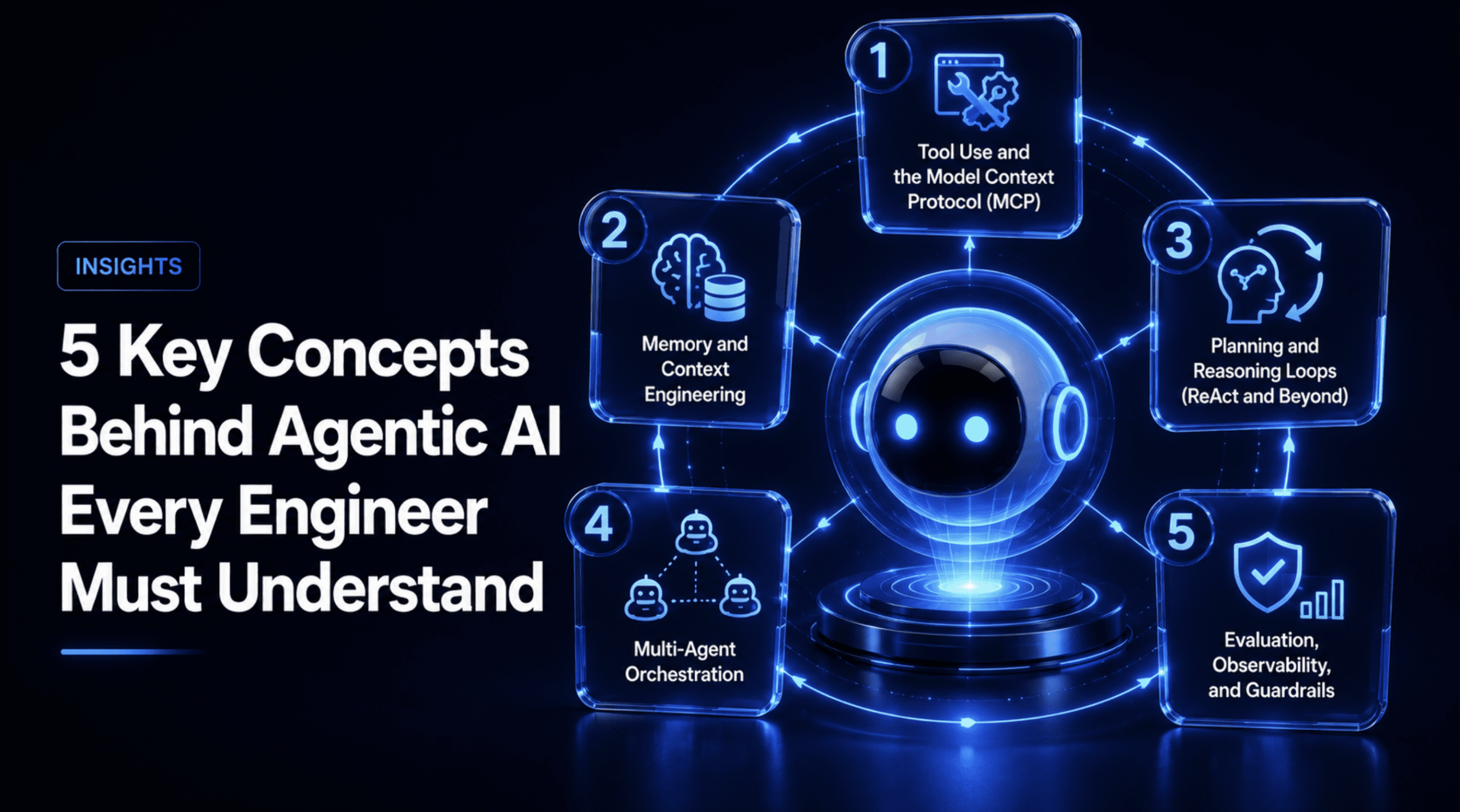
This article walks through and explains the five ideas that actually hold agentic systems together.
# Introduction
If you ask a chatbot to find you a hotel in London, it will give you a list of names and let you do the rest. If you ask an agent, it checks availability, compares prices across sites, books the room, and emails you the confirmation. That gap between "telling you something" and "doing something on your behalf" is the entire story of agentic AI, and it's why the term has gone from a research footnote to a line item in almost every engineering roadmap for 2026.
The hard part isn't the pitch. Everyone gets the pitch. The hard part is that "agentic AI" is now a stand-in for five or six distinct engineering ideas that get mashed together in marketing decks, and if you don't separate them, you end up with an agent that can't remember a conversation, can't talk to the tools it needs, or works fine in a demo and falls apart the moment real traffic hits it. Roughly 88% of AI agents built today never make it to production, and a large chunk of that failure has nothing to do with the underlying model. It comes down to whether the engineering team understood these five concepts before they started building.
This article walks through the five ideas that actually hold agentic systems together: how agents reach outside themselves to use tools, how they remember anything at all, how they decide what to do next, how multiple agents work as a team instead of stepping on each other, and how anyone knows if the whole thing is actually working. Resources and frameworks are linked throughout, so you can go deeper on whichever piece matters most to what you're building.
# 1. Tool Use and the Model Context Protocol
An large language model (LLM) by itself can only generate text. The moment you want to check a database, call an API, read a file, or send an email, you need a bridge between the model's reasoning and the outside world. That bridge is what people mean by "tool use," and for years, building it meant writing a custom integration for every single combination of model and service. Ten AI applications and a hundred tools used to mean something close to a thousand brittle, one-off integrations.
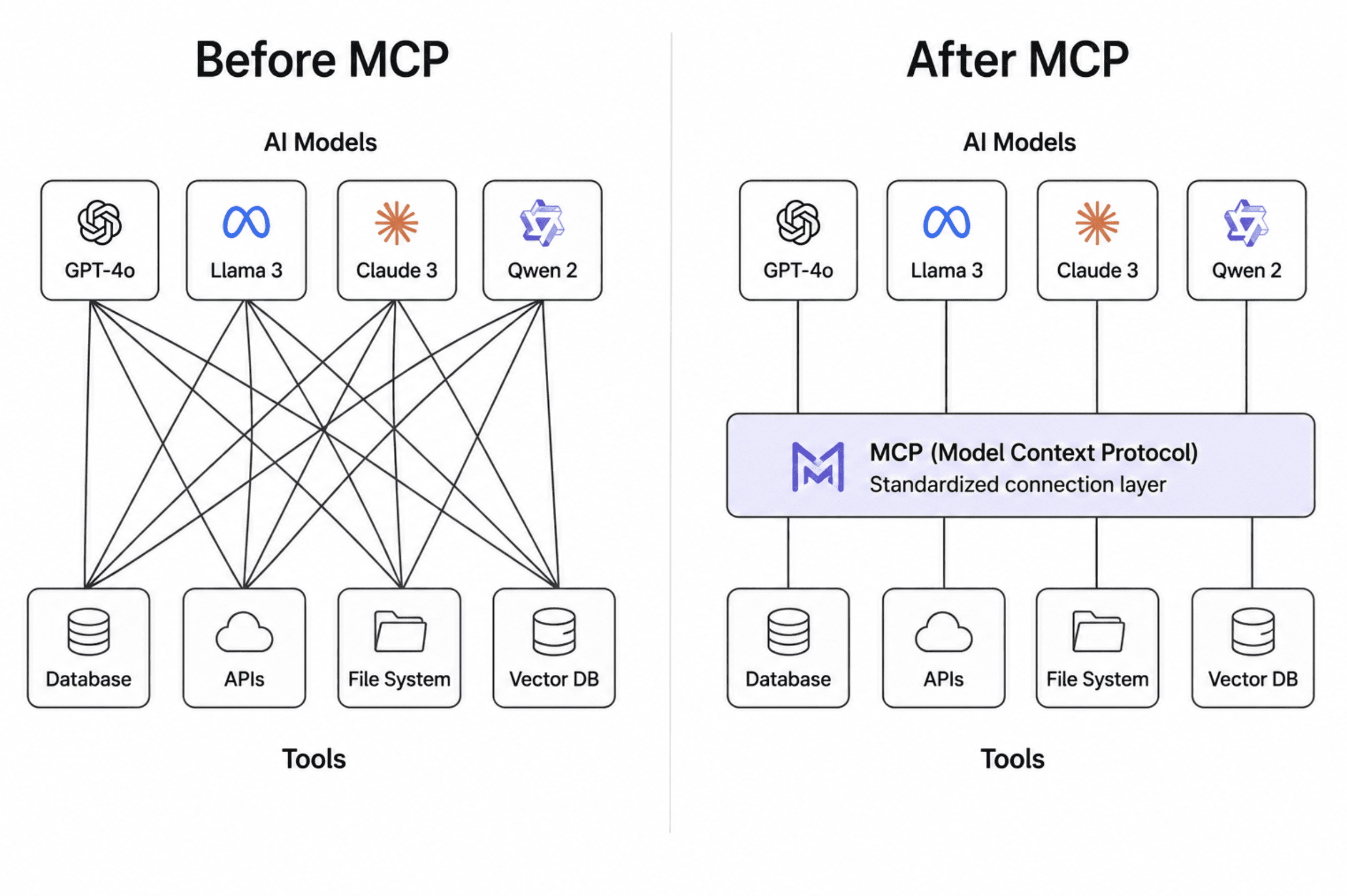
Anthropic introduced the Model Context Protocol (MCP) in November 2024 to solve exactly this problem, and the adoption curve since then has been hard to overstate. By March 2026, the official SDKs were pulling in 97 million monthly downloads, up from roughly 100,000 in the first month after launch — a jump that took the React npm package three years to reach and MCP about sixteen months. In December 2025, Anthropic donated MCP to the newly formed Agentic AI Foundation under the Linux Foundation, with OpenAI and Block joining as co-founders and AWS, Google, Microsoft, Cloudflare, and Bloomberg as supporting members, which is the kind of move that turns a vendor's protocol into shared infrastructure nobody can quietly deprecate.
What matters for an engineer isn't the download count, though. It's what the protocol actually standardizes: a model can ask any MCP-compliant server what it's capable of, then call its tools using the same JSON-RPC pattern every time, regardless of who built the server. The client discovers available tools through the server's capability manifest and invokes them by sending standard requests, which means you stop rebuilding the same plumbing for every new integration. If you're connecting an agent to Slack, Notion, GitHub, or a database, there's a real chance someone already built and published the MCP server for it. The official MCP registry and community directories like PulseMCP are good starting points before you write a custom integration from scratch.
The honest caveat worth knowing: MCP isn't free. It adds genuine token overhead compared to a direct API call, and for high-throughput pipelines where every token counts, plenty of teams in 2026 are sticking with lean CLI-based or direct calls instead. MCP earns its place when you need OAuth handled properly, when you're serving multiple tenants with strict data boundaries, or when non-engineers on your team need to plug an agent into a tool without writing an SDK integration themselves.
# 2. Memory and Context Engineering
Every LLM call is stateless by default. The model has no idea what happened five minutes ago unless you put it back in front of it. For a single question-and-answer exchange, that's fine. For an agent handling a customer over multiple sessions, running a multi-day research task, or managing a project that spans weeks, a model that forgets everything between calls is basically useless, no matter how smart it is in the moment.
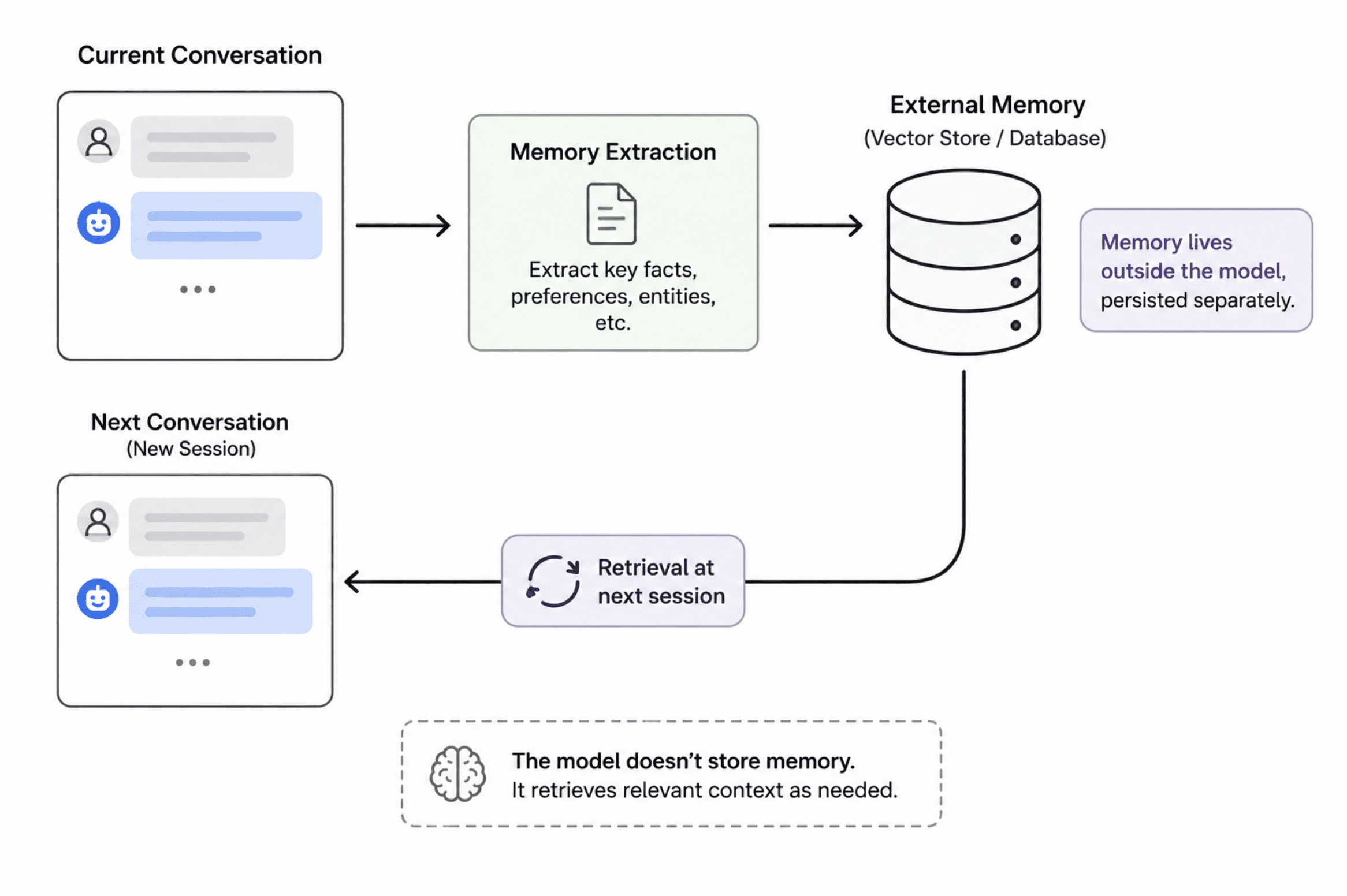
This is where memory stopped being an afterthought and became its own discipline. Three years ago, agent memory meant stuffing conversation history into the context window and hoping the model kept track. That's no longer how serious systems are built. Memory is now treated as its own architectural component, separate from the context window, with its own benchmarks and a measurable gap between approaches that actually work and ones that don't.
The mechanics are fairly simple once you see them laid out. During a conversation, a memory layer extracts the facts worth keeping and stores them in a vector database, tagged by user, session, and agent. When a new session starts, the system retrieves whatever is relevant using a mix of semantic similarity, keyword matching, and entity matching, then quietly injects only that slice into the model's context before it responds. The agent looks like it remembers you. What's actually happening is a targeted retrieval step running before every reply.
Tools like Mem0, Zep (built on a temporal knowledge graph called Graphiti), and Letta have become the default starting points rather than something teams build from scratch. The difference between them is mostly about what kind of memory you need. Mem0 is the easier, broader option for drop-in personalization. Zep scores noticeably higher on temporal reasoning — the kind of query like "how did this customer's behavior change after the pricing update" — because it tracks facts with a start and end validity window rather than just storing the most recent or most similar entry.
The term you'll hear alongside memory now is "context engineering," and it's worth understanding why that phrase replaced "prompt engineering" in a lot of conversations. Context quality, not volume, has become the real limiting factor for LLM agents. Most teams don't come close to using the full context window their models technically support, and the actual challenge is selecting, compressing, and structuring the information that genuinely drives the model's decisions rather than just dumping everything in. A bigger context window doesn't fix a sloppy retrieval strategy. It just gives sloppiness more room to hide.
# 3. Planning and Reasoning Loops
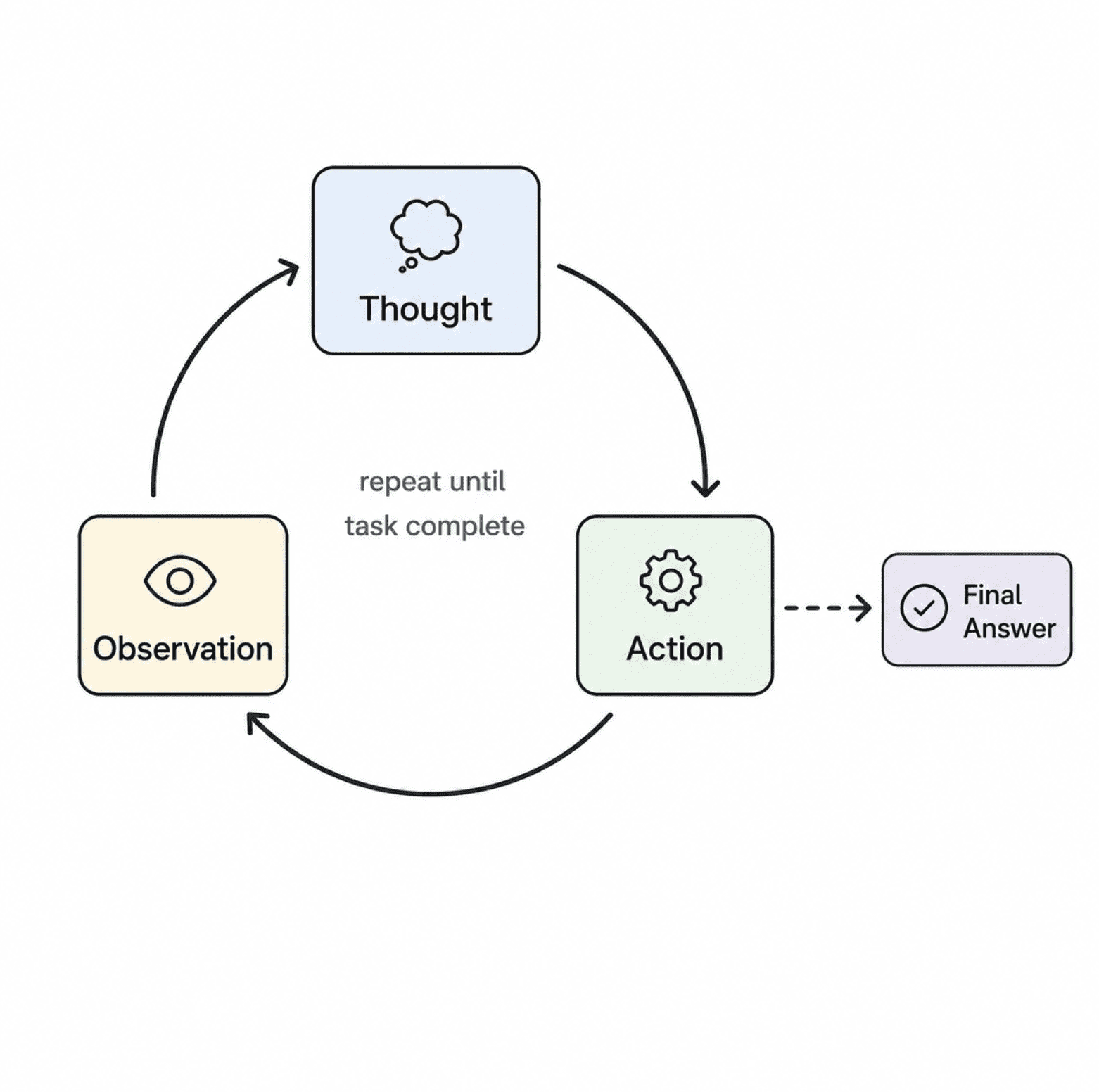
A chatbot answers once and stops. An agent has to decide what to do, do it, look at what happened, and decide again — sometimes dozens of times in a row — without a human prompting it at every step. That loop is the actual mechanical difference between "AI that talks" and "AI that works," and almost every agent framework you'll encounter today is some variation on the same core pattern.
That pattern has a name and a specific origin. In late 2022, researchers from Google and Princeton published ReAct: Synergizing Reasoning and Acting in Language Models, which proposed having the model interleave reasoning steps with actions rather than treating them as separate tasks. The structure is simple to describe: the model produces a thought, takes an action based on that thought, observes the result, and produces another thought based on what it just saw. On benchmarks involving question answering and interactive decision-making, this approach beat both pure imitation learning and pure reinforcement learning by a wide margin while needing only one or two examples to work.
What's changed since 2022 isn't the core loop; it's how much structure sits around it. Chain-of-thought, ReAct-style reasoning, and few-shot prompting used to be the whole toolkit. By 2026, this has evolved into what people call context engineering, which is about designing the entire information environment around the model rather than just the prompt that kicks off the loop. Modern agent frameworks add retry logic, self-correction when a tool call fails, and explicit task decomposition so a vague goal like "research this market and summarize the competitive landscape" gets broken into steps the model can actually verify one at a time.
This is also where reliability problems tend to surface first. A reasoning loop that runs unchecked can burn through tokens fast, get stuck retrying the same failed action, or wander off the original goal entirely. Data from production traces shows that a meaningful share of LLM call failures in agent systems come from exceeded rate limits during exactly these kinds of repeated, looping calls — which is a useful reminder that the planning loop isn't just a reasoning concept; it's something you have to budget and monitor like any other piece of infrastructure.
# 4. Multi-Agent Orchestration
A single agent with a single context window has a ceiling. Feed it an entire codebase, a long research brief, and a set of business rules all at once, and somewhere in there, it starts losing track of details, especially the ones buried in the middle of all that context. The fix that's become standard in 2026 isn't a bigger model. It's splitting the work across multiple agents, each with its own focused context, coordinated by something sitting above them.
The pattern is usually described as an orchestrator and sub-agents: one orchestrator agent coordinates specialized sub-agents, each working with a dedicated context, in parallel, rather than one agent trying to hold everything in its head at once. This isn't a theoretical improvement either. Fountain, a hiring platform, used hierarchical multi-agent orchestration to achieve 50% faster candidate screening and 40% quicker onboarding, cutting one customer's staffing time from weeks down to under 72 hours.
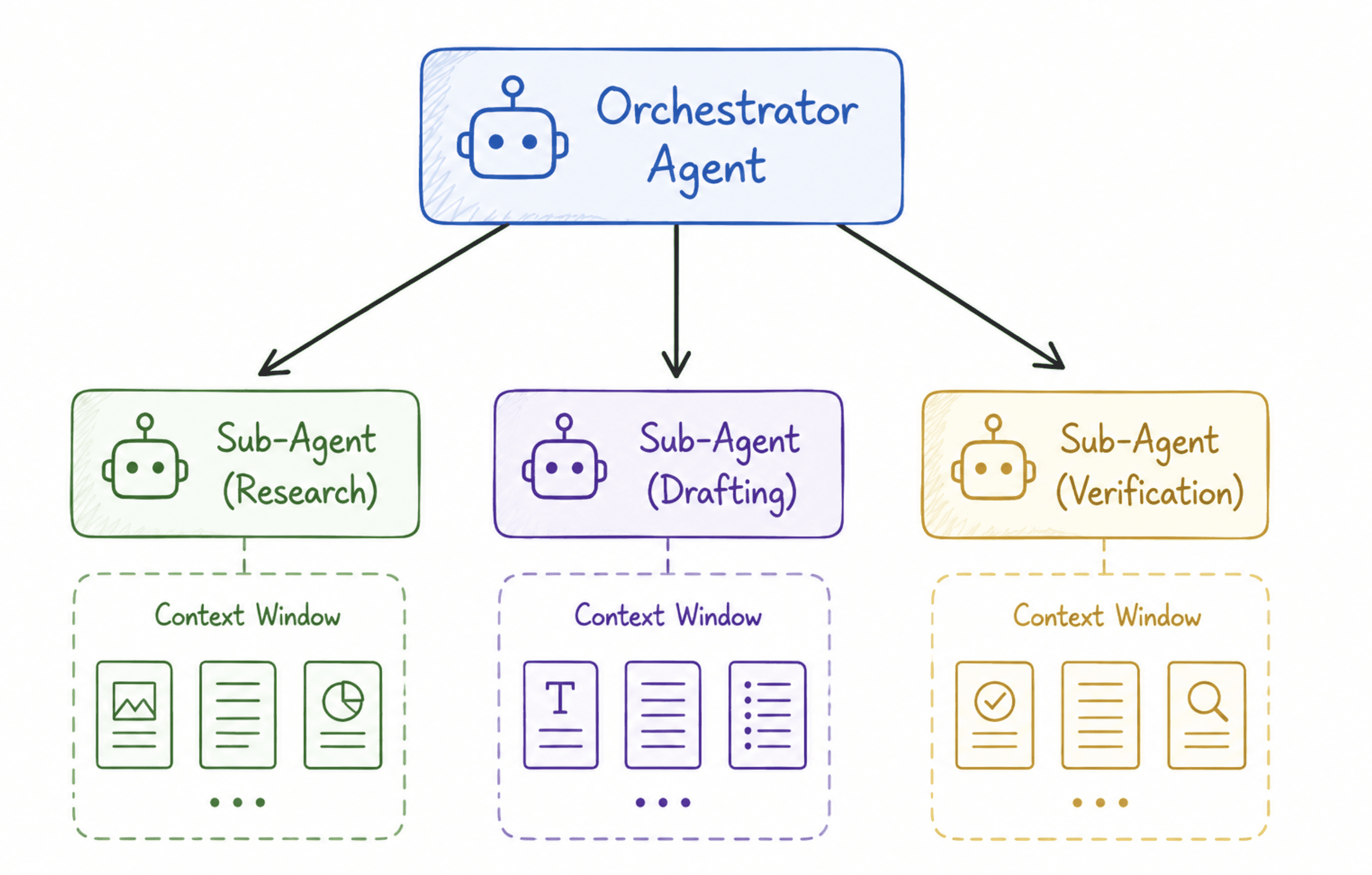
If you're choosing how to build this yourself, the framework landscape has settled into a few clear lanes rather than dozens of competing options. LangGraph has the steepest learning curve of the major options but offers the most control and the most mature production readiness, with built-in checkpointing and explicit state management. CrewAI is the easiest to pick up, structuring multi-agent work around roles and tasks, and is the most intuitive choice when work splits naturally into specialist roles. AutoGen leads in research and academic settings with flexible conversational patterns between agents, though production adoption trails the other two. None of these is universally "best." The right pick depends on whether your team needs fine-grained control or fast time-to-prototype.
The other half of this concept is letting agents built on different frameworks talk to each other at all, which is a separate problem from giving one agent access to tools. Google introduced the Agent2Agent (A2A) protocol in April 2025 specifically for this, and it's now housed under the Linux Foundation as an open-source project. Where MCP standardizes how an agent talks to tools, A2A standardizes how agents talk to other agents, letting them discover each other's capabilities and collaborate on a task without exposing their internal memory or logic to one another. The two protocols are designed to complement each other rather than compete, and seeing both named in a system's architecture is becoming a normal thing to expect by mid-2026.
# 5. Evaluation, Observability, and Guardrails
This is the concept that decides whether everything above actually ships, and it's the one engineers tend to underinvest in because it's the least exciting part of the build. The numbers explain why it can't stay an afterthought. Roughly 88% of AI agents fail to reach production, but the ones that do make it return an average 171% ROI. That's not a small gap. It's the difference between a project that gets quietly shelved and one that becomes a genuine competitive advantage, and the gap is mostly closed by engineering discipline rather than a better model.
What does that discipline actually look like in practice? It starts with tracing — the ability to see exactly what an agent did at every step, which tool it called, what it observed, and where it went wrong. LangSmith, paired with LangGraph, has become a common choice for this kind of framework-agnostic tracing and systematic debugging in production, and similar tooling exists across the other major frameworks. Without this, debugging an agent that misbehaved in production means guessing, because you have no record of the reasoning that led it there.
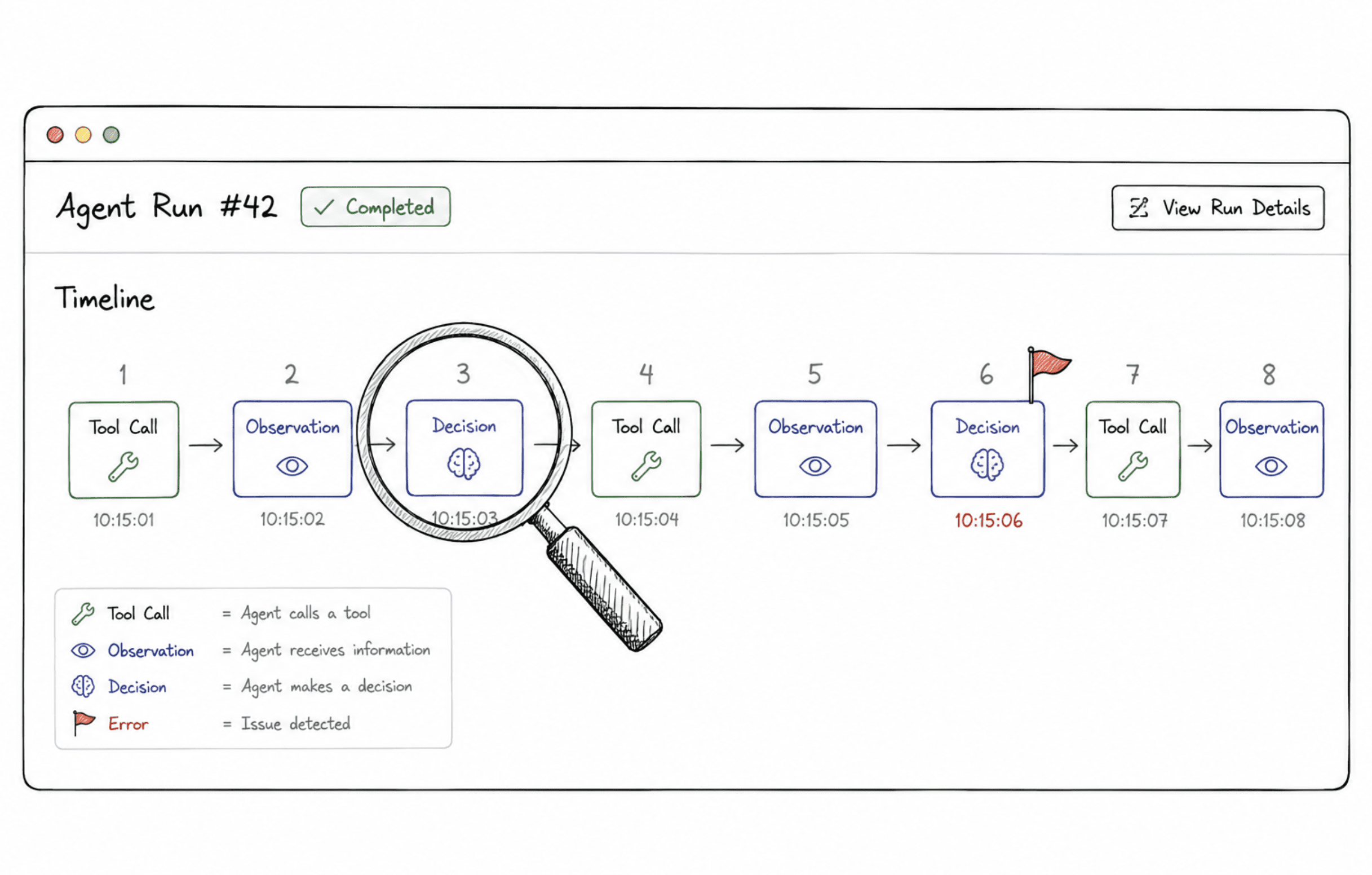
Evaluation is the second half, and it's distinct from tracing. Tracing tells you what happened. Evaluation tells you whether it was actually good. Microsoft's newer tooling in this space, for instance, includes a rubric evaluator that automatically generates evaluation criteria based on an agent's specific context, then scores its performance against weighted dimensions for a more nuanced quality view than a simple pass or fail. The broader industry has also started standardizing where exactly in an agent's lifecycle you place safety checks. One emerging approach defines five validation checkpoints across an agent's run, covering input, the model's own reasoning, internal state, tool execution, and final output — expressed as a portable, versionable policy rather than scattered custom code.
None of this replaces human judgment; it just tells you where to point it. Gartner has predicted that more than 40% of agentic AI projects will be canceled by the end of 2027, with escalating costs, unclear business value, and inadequate risk controls as the main drivers, and every one of those failure modes is something evaluation and observability are built to catch early — before they turn into a canceled project instead of a fixable bug.
# Wrapping Up
None of these five concepts works well in isolation. An agent with great tool access but no memory forgets every lesson it just learned. An agent with a solid reasoning loop but no orchestration hits a wall the moment the task gets too big for one context window. An agent that does all of the above but has no evaluation layer is a black box you're hoping behaves itself in production. The engineers getting real value out of agentic AI in 2026 aren't the ones who picked the flashiest framework. They're the ones who understood how tool use, memory, planning, orchestration, and evaluation fit together as one system, and built accordingly.
If you're starting from scratch, you don't need all five mastered before you write a line of code. Pick one well-scoped task, wire up a single agent with MCP for tool access and a basic memory layer, watch how it reasons through a few real runs, and only reach for multi-agent orchestration once a single agent genuinely can't handle the scope. Evaluation should be there from day one, not bolted on after something breaks. That order, more than any specific framework choice, is what separates the agents that make it to production from the 88% that don't.
Shittu Olumide is a software engineer and technical writer passionate about leveraging cutting-edge technologies to craft compelling narratives, with a keen eye for detail and a knack for simplifying complex concepts. You can also find Shittu on Twitter.