


OpenAI Dots: The Data Scientist’s Reality Check
Dots promises a lot. Before you hand it the keys to your workflow, here's what practitioners need to know.
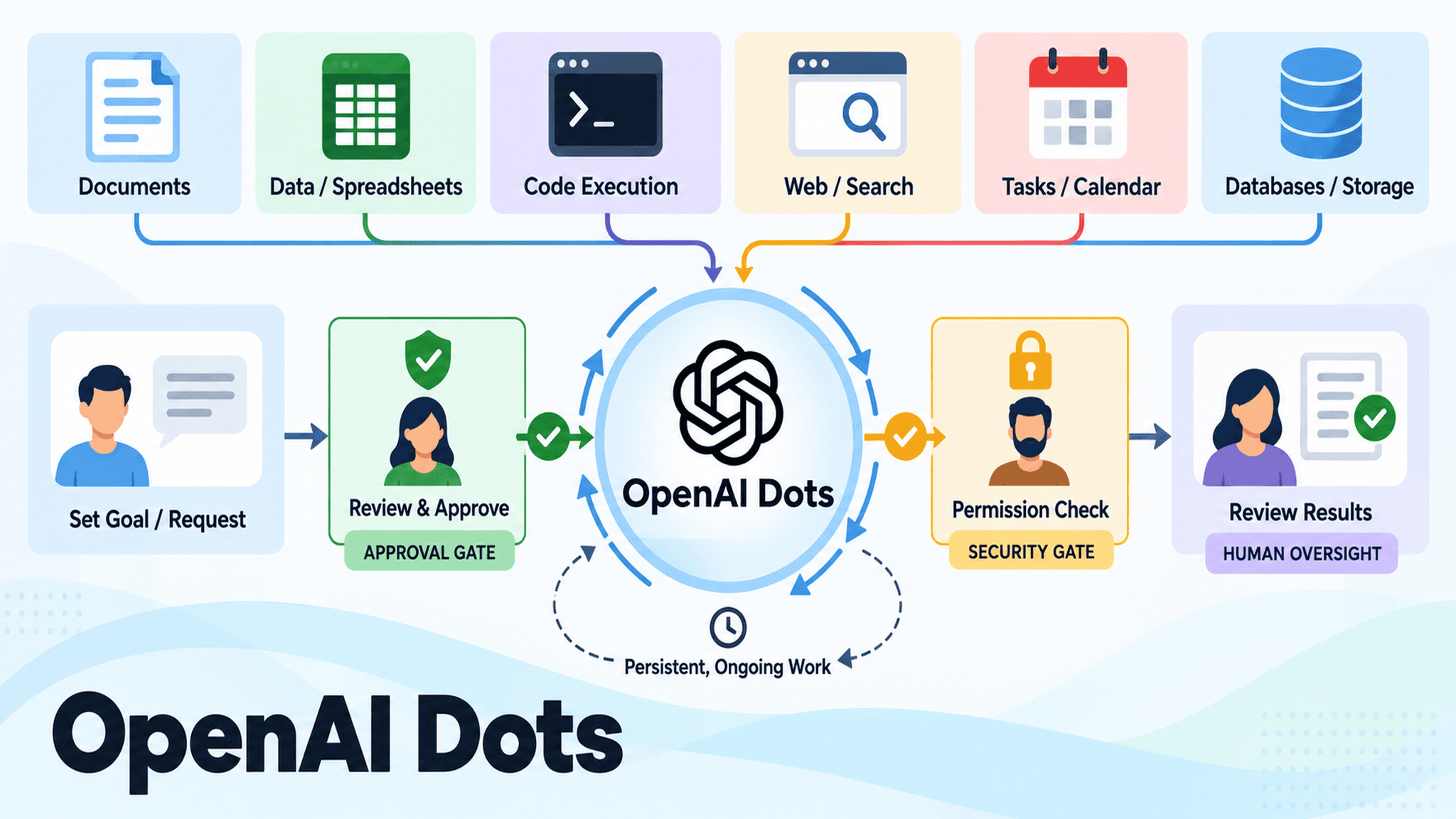
On September 29, OpenAI announced Dots at its DevDay 2026 conference: always-on AI agents that run on their own cloud computers, connect to more than 4,000 apps, and keep working after you close your laptop. It's the most concrete version yet of something the AI industry has been describing for years: an agent that acts more like a coworker than a chatbot.
For the data science and machine learning community, Dots deserves more than a quick skim of the announcement. It introduces a genuinely different model for how AI fits into your workflow. It also arrives with enough open questions that the right response, for now, is informed skepticism rather than immediate adoption.
What Dots Actually Is
The core shift here is from reactive to proactive. Standard ChatGPT responds when you prompt it and stops when the session ends. A Dot has its own cloud computer, runs GPT-6 Astra, and can pursue a standing goal across connected apps between your conversations. No re-prompting required.
OpenAI's own examples give a sense of the intended use. One early tester's Dot noticed an invoice she needed to send, pulled the relevant details from an email thread, and drafted it for her approval. Another involves a Dot watching customer feedback, scoping fixes, building and testing them, then returning pull requests with videos attached, ready for a developer to review.
The delegation model Sam Altman described in the keynote is direct: hand off work the way you would to a high-agency engineer or a chief of staff who already knows the context. The Dot learns your preferences from feedback over time, so corrections carry forward rather than requiring re-explanation every session.
You can reach a Dot through ChatGPT, Slack, or Microsoft Teams, and by voice. At launch, a Dot can't have its own standalone email address, can't initiate calls, and texting is still limited to a US Pro beta.
What Makes This Different From Earlier Agent Features
This distinction matters if you've tried OpenAI's earlier agent capabilities and found them brittle on anything longer than three or four steps.
What changed is GPT-6 Astra's reliability on multi-step, multi-tool tasks. Earlier approaches tended to drift: losing context partway through a job, making incorrect assumptions when they hit friction, or stopping to wait for input rather than pushing through. Astra is specifically built for the kind of sustained, tool-using work a background agent requires.
The second distinction is persistence. A Dot isn't a session-level feature. It retains context between conversations, builds a working model of your preferences, and can operate on a standing goal you set once rather than one you re-explain every time you open a chat window. That's a fundamentally different relationship with an AI tool than most practitioners currently have.
Whether this holds up on genuinely messy data work, exploratory analysis that changes direction, long research threads, collaborative environments with multiple contributors — is still being proven out. The early examples are well-chosen to show the product at its best. The real test is how it handles the ambiguous, high-volume tasks that define most practitioners' actual weeks.
The Practical Constraints Worth Knowing
The availability picture is narrower than the headline suggests. At launch, Dots is available to ChatGPT Pro subscribers (starting at \$100 per month) and Business Premium users. Free, Go, and Plus plans don't include a Dot. Pro users in the European Economic Area, Switzerland, and the United Kingdom are excluded at this stage.
The privacy trade-offs deserve direct attention. A Dot learns from your feedback and retains context, but users currently can't view, modify, or delete individual Dot memories. Disconnecting a plugin doesn't erase the context the Dot previously retained from it. For practitioners handling sensitive data, proprietary models, or client-side work, that's a concrete limitation, not a minor footnote.
OpenAI also hasn't published Dots-specific compliance terms, uptime guarantees, or pricing for additional Dots beyond the first. That matters for teams evaluating whether Dots fits inside their existing security and procurement requirements.
Worth noting directly from OpenAI's own materials: Dots can still make mistakes, so always review consequential work. That's not boilerplate. It's the correct operating assumption for any autonomous agent at this stage of the technology.
What It Means for How Practitioners Work
The shift Dots represents is less about capability and more about responsibility. A chatbot requires you to drive every step. An always-on agent requires you to set clear goals, design sensible permission boundaries, and build review checkpoints into the workflow.
For data scientists specifically, the opportunity is in the category of work that drains time without requiring deep thinking: chasing status updates, monitoring job outputs, keeping documentation current as specs change, preparing summaries across long conversation threads. These are tasks where a persistent agent with good memory and app access could genuinely compress hours into minutes.
The risk is treating that capability as a reason to reduce oversight. An agent working in the background on a data pipeline or a model evaluation process needs narrow, explicit permissions and clear stopping conditions. The same properties that make Dots useful — proactive behavior, persistence, app access — are exactly what make it worth setting boundaries before you switch it on, not after.
Final Thoughts
The always-on agent concept has been announced and not quite arrived several times now. Dots is the most credible version yet. What stands out most, though, isn't the product itself. It's what the product requires of the user.
Getting value from Dots isn't primarily a technical task. It's a clarity task. You have to know which parts of your workflow you're comfortable delegating, what outputs require your sign-off, and which data you're not willing to put through a shared, hosted agent. Most practitioners haven't thought about their own work at that level of resolution.
That may be the most useful thing about always-on agents arriving in a usable form. Not that they do the work, but that using them well forces you to articulate what the work actually is. For practitioners who do that thinking carefully, Dots has real potential. For those who connect all their apps, set a vague goal, and walk away, the correction is going to be expensive.
The agent is only as good as the brief you give it. That's always been true. Now it matters more.
Vinod Chugani is an AI and data science educator who bridges the gap between emerging AI technologies and practical application for working professionals. His focus areas include agentic AI, machine learning applications, and automation workflows. Through his work as a technical mentor and instructor, Vinod has supported data professionals through skill development and career transitions. He brings analytical expertise from quantitative finance to his hands-on teaching approach. His content emphasizes actionable strategies and frameworks that professionals can apply immediately.