


What Senior Data Science Job Postings Actually Ask for in 2026
A data-backed breakdown of the skills, credentials, and capabilities that hiring managers are screening for in senior roles right now.
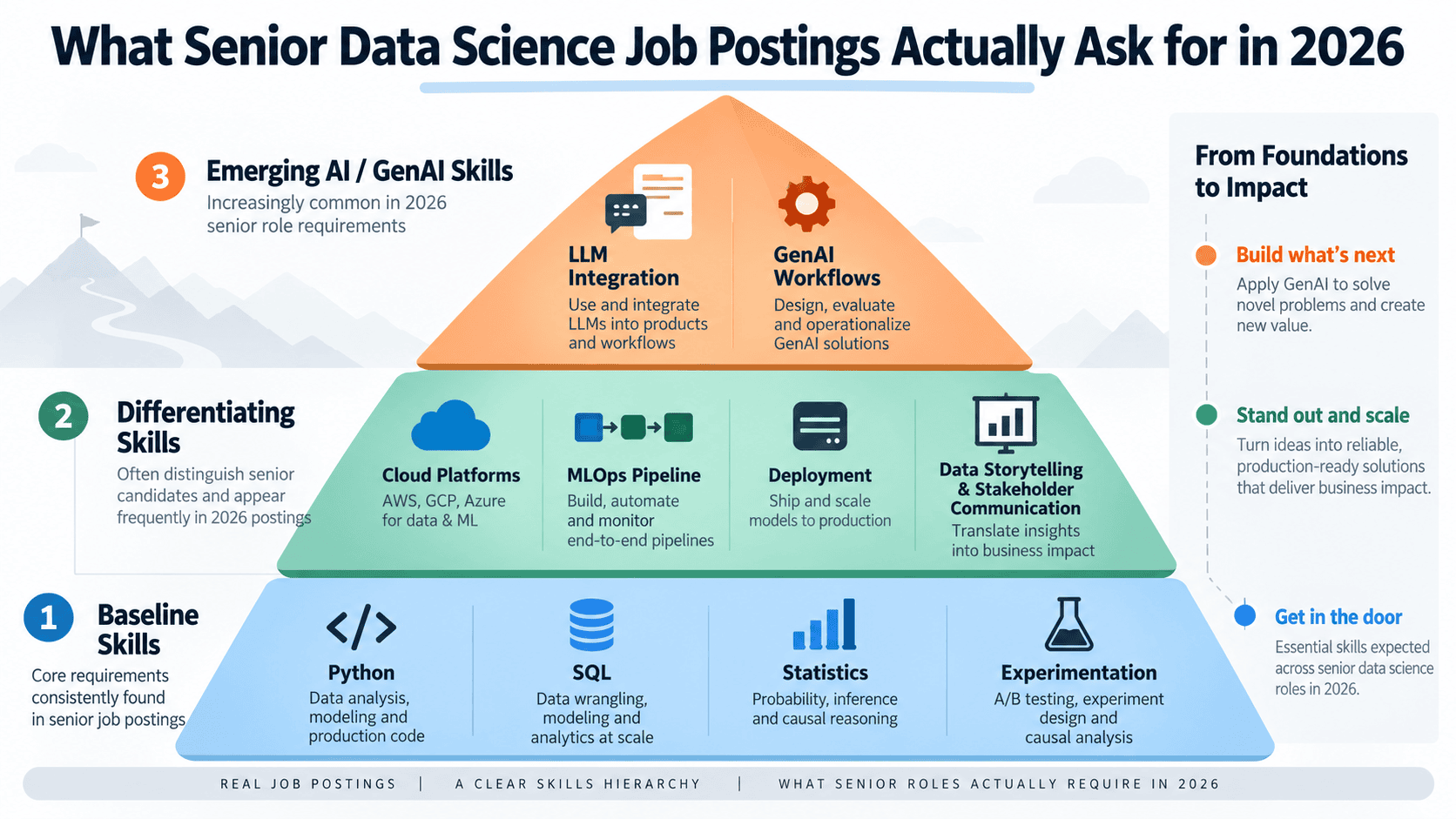
There's a persistent gap between what data scientists think employers want and what hiring managers actually write into job descriptions. That gap is widest at the senior level, where requirements have shifted more in the past two years than in the previous five combined.
In 2026, senior data scientist postings reflect a field that has moved decisively beyond the "build a model in a notebook" era. Employers are screening for production-grade technical depth, comfort with AI tooling that didn't exist two years ago, and a set of business and communication skills that many technically strong candidates still underestimate.
This article draws on analyses of thousands of active U.S. job postings, including a detailed review of 500 postings from LinkedIn, Indeed, and Glassdoor; an analysis of 7,000+ postings for AI skill frequency; and job market data from 12,148 postings tracked by Axial Search. The goal is to show exactly what senior data science roles ask for in 2026. The findings are specific, and some of them will surprise you.
The Baseline Has Risen: What "Table Stakes" Looks Like Now
The first thing the posting data makes clear is that skills once considered advanced have become entry requirements at the senior level. Three things appear in the majority of all data science postings, senior or otherwise, and none of them are optional.
Python (74% of Postings)
Python continues to dominate as the most frequently required language across all data science roles. The postings have become more specific about which Python skills they want, though. The 2026 market is not looking for pandas fluency alone. Senior role descriptions routinely call out scikit-learn for machine learning pipelines, PyTorch or TensorFlow for deep learning, FastAPI or Flask for model deployment, and increasingly, LangChain or LlamaIndex for large language model (LLM) integrations. If your Python skills stop at data manipulation and basic visualization, you sit in the bottom half of the candidate pool for most senior positions.
SQL (64% of Postings)
SQL continues to appear in nearly two-thirds of all data science postings, and that number climbs when you look specifically at senior roles. What has changed is the depth expected. Senior postings increasingly specify advanced SQL capabilities: window functions such as ROW_NUMBER, RANK, and LAG/LEAD; complex common table expressions and nested subqueries; query optimization and execution plan analysis; and familiarity with cloud-native SQL variants like BigQuery SQL, Snowflake SQL, and Redshift SQL. For senior roles, vanilla SQL is not enough.
Machine Learning (69% of Postings)
Machine learning appears in 69% of data scientist job postings. At the senior level, the emphasis has shifted from building models to owning them across their full lifecycle. Postings now call out MLOps far more consistently than classical algorithm knowledge. Feature engineering and model interpretability (SHAP, LIME) appear regularly in regulated industries such as finance and healthcare. The clearest signal in the 2026 data: employers want people who can deploy and maintain models, not just train them in a Jupyter notebook.
What Sets Senior Roles Apart: The Skills That Separate Levels
Beyond the baseline, several skill categories differentiate senior postings from mid-level ones. These are the requirements that most frequently appear specifically at the senior and staff levels.
Cloud Platform Fluency (62% of Postings, Higher at Senior Level)
Cloud expertise has become structural rather than supplementary. In an analysis of 500 postings, 62% mentioned at least one cloud platform. The breakdown by platform: Microsoft Azure at 28.5%, AWS at 19.7%, Google Cloud Platform at 14.2%, Snowflake at 11.8%, and Databricks at 9.3%.
Senior postings go further than mid-level ones in what they expect. Rather than general cloud familiarity, they specify services: AWS SageMaker for machine learning workflows, AWS S3 and EC2 for storage and compute, Google Vertex AI, Azure ML, and BigQuery for data processing. The underlying message is that a senior data scientist should be able to deploy and scale production systems on their preferred cloud, not just run notebooks on it.
One notable finding: approximately 20% of data science job postings explicitly request a cloud certification. The AWS Certified Machine Learning Specialty (9.3% of postings), Azure Data Scientist Associate DP-100 (8.4%), and Google Professional Data Engineer (7.1%) lead the list. Postings that specify a cloud certification tend to carry noticeably higher salary bands.
MLOps and Production Skills (Increasingly Required at Senior Level)
The shift from modeling to production systems is the defining technical change in senior data science requirements over the past two years. Senior postings now routinely include tools such as MLflow for model tracking and versioning, Apache Airflow for workflow orchestration (mentioned in nearly 9% of all data science postings, skewing toward senior roles), dbt for analytics engineering, Docker and Kubernetes for containerization and deployment, and CI/CD pipelines through GitHub Actions or Jenkins.
An analysis of 12,148 U.S. data science postings found that hands-on technical execution ranks higher than boardroom influence as the defining leadership characteristic employers screen for. The practical implication: senior data scientists are expected to build and ship, not just direct others who do.
Generative AI and Large Language Model Skills (31% of Postings, Climbing Fast)
This is the fastest-growing requirement category in the 2026 posting data. Across 500 postings analyzed between April and May 2026, 31% explicitly mentioned generative AI (GenAI), LLMs, or prompt engineering skills. That figure was effectively zero in 2023.
A separate analysis of more than 7,000 postings found that AI skills appear in roughly two out of three postings overall, with about half expecting candidates to have specific AI skills or work on AI projects. Among AI skills, LLMs lead, with approximately one in four postings naming them specifically. Retrieval-augmented generation (RAG), AI agents, and natural language processing follow.
AI requirements concentrate at the mid and senior levels. Research from the FutureProof Data Science newsletter found that 73% of postings mentioning AI skills target mid-level (43%) and senior-level (30%) roles, while entry-level postings account for less than 6%. This confirms that AI fluency is now an expectation for experienced practitioners, not a specialist add-on.
The specific skills appearing in senior postings include:
- Experience with LLM APIs (OpenAI, Claude, Gemini)
- RAG implementation and vector database management (Pinecone, Weaviate, Chroma)
- Agentic AI workflow design, including multi-agent orchestration using LangChain, CrewAI, or AutoGen
- Prompt engineering, listed by name in 14% of postings
- LLM fine-tuning and evaluation methods
Real senior job postings from 2026 illustrate the pattern directly. Wells Fargo listed "strong full-stack agentic AI skills" as a requirement for its Agentic AI Senior Lead Data Scientist role. The American Chemical Society posted a senior role requiring hands-on production experience with LLM applications, RAG, multi-agent systems, and model fine-tuning. Deloitte's senior consulting role asked for experience architecting end-to-end agentic systems that combine LLMs with enterprise data pipelines. These are not edge cases. They reflect a broad shift in how senior data science work is defined.
Statistics and Mathematics (58% of Postings)
Statistical depth remains a consistent requirement at the senior level. Postings specifically call out probability theory and statistical inference, A/B testing and hypothesis testing design, Bayesian statistics, regression analysis, and time series forecasting. The graduate-degree correlation is strong: in roles requiring a master's or PhD, statistics was the most consistently named foundational skill.
The reasoning behind this sustained emphasis is telling. As automated machine learning tools lower the barrier to building models, understanding why a model works and when it will fail becomes the differentiator at senior levels. Employers want practitioners who can evaluate model choices, not just implement them.
Data Visualization and Storytelling (53% of Postings)
More than half of all postings mention data visualization, and at the senior level the expectation moves beyond tool proficiency. Senior postings frame this as "data storytelling at the executive level." That means communicating model outputs and analytical findings to non-technical decision-makers in ways that actually drive action.
The tool breakdown: Tableau appears in 28.1% of postings, Power BI in 24.7%, Matplotlib and Seaborn in 21.4%, and Looker or Looker Studio in 9.7%. Notably, Tableau postings correlate with advanced SQL requirements and business communication skills, while Power BI postings align with Azure and Microsoft ecosystem requirements. Choosing one visualization platform and aligning it with your cloud platform of choice is a sensible strategy for senior-level positioning.
The Credentials Picture: Degrees, Experience, and What Actually Matters
Experience Requirements
Senior data scientist roles in the U.S. ask for a median of five years of experience, according to job posting analysis from Axial Search covering 12,148 postings. The progression across seniority levels: junior roles expect two years, mid-level roles ask for a median of four, senior roles ask for five, principal roles for seven, and director-level roles for ten or more.
One pattern has shifted notably since 2025. In 2025, positions requiring six to eight years were the least common, followed by positions requiring eight-plus years and entry-level positions. By 2026, entry-level positions became the least common, reflecting a more selective, senior-weighted hiring market. The entry-level market is competitive. Mid-level and senior roles remain undersupplied.
Education Requirements
Data science continues to be the most credentialed AI function in the job market. An analysis of postings from Axial Search found that 93% of data science postings require a degree, higher than any other AI function tracked. Among postings that specify a degree level, 30% require a master's degree and approximately 34–35% mention or prefer a PhD. PhD mentions increased notably from 2025 to 2026.
Separately, 365 Data Science's analysis of 827 active listings found that 26% of postings do not specify a degree at all, up significantly from previous years, while 30% require a master's and 24% still require a PhD. The direction is clear: demonstrated work is gaining ground relative to credentials.
For most industry roles, a master's degree paired with a strong production portfolio remains the optimal credential profile. Research lab or quantitative finance positions are a different story. A PhD adds the most value in research-heavy environments or when targeting frontier AI labs. For practitioners without a graduate degree, the posting data is consistent: a portfolio of shipped models, clean GitHub repositories, and demonstrated production experience carries more weight than a list of certifications.
Certifications
Certifications barely register as requirements in the posting data. An analysis of 12,148 postings found that the entire top-eight certification list combined accounts for less than 2% of postings. Nothing comes close to being a standard requirement. Cloud certifications are the exception. They appear in roughly 20% of postings and correlate with higher salary bands. If you hold a cloud certification, list it. If you don't, prioritize building production-grade projects over pursuing non-cloud certifications.
A separate survey found that 78% of hiring managers say they care more about portfolio projects than certifications. A GitHub repository with three solid end-to-end projects outweighs a certificate list in the vast majority of hiring conversations.
The Skills That Don't Show Up in Job Descriptions (But Get You the Role)
The posting data reveals one category that hiring managers mention far more than most candidates expect: communication and cross-functional influence.
In the 500-posting analysis, "communicate insights to non-technical stakeholders" appeared in 47% of all data science postings. "Work cross-functionally" appeared in 39%. "Leadership and mentoring junior analysts" appeared in 19%. At the senior level, these figures are higher.
This pattern reflects a structural shift in what employers value. As one DataCamp analysis put it, GenAI has made basic coding tasks routine, shifting what employers value toward problem framing, business judgment, and the ability to communicate technical findings to non-technical stakeholders.
In practice, senior postings consistently expect that the candidate can:
- Translate ambiguous business goals ("reduce customer attrition") into measurable, solvable data problems
- Present model outputs and analytical findings to executive stakeholders without technical jargon
- Partner with product, engineering, and business teams across the full model lifecycle
- Mentor junior data scientists and set technical standards for the team
- Evaluate when a machine learning solution is appropriate and when it is not
Axial Search's leadership capability analysis puts it plainly: data science employers screen for execution and AI literacy above strategy and influence. The ideal senior candidate in 2026 is someone who builds things, explains what they built, and connects the output to a business outcome.
Where the Jobs Are: Industry Distribution
An analysis of 500 postings found that 85–88% of active data science roles now come from outside FAANG and major tech platforms. The breakdown by industry: Technology and Engineering at 28.2%, HR/Staffing at 19%, Health and Life Sciences at 13%, Financial and Professional Services at 10%, Retail and E-commerce at 8.4%, and Manufacturing at 8.7%.
Healthcare is the fastest-growing vertical for data science hiring. Financial services remain a top-paying sector. Mid-size enterprise technology companies, regional banks, hospital systems, and manufacturers undergoing AI adoption are generating the largest volume of senior data science openings.
For practitioners optimizing their job search, the implication is to broaden beyond the most visible employers. The senior roles with the most competitive compensation packages — and sometimes with the strongest scope for ownership and impact — are not always at the companies with the most prominent brand names.
A Practical Reading of the Posting Data
Pulling the research together, senior data science postings in 2026 describe a profile that is more demanding than it was three years ago, in specific and predictable ways. Here's the clearest picture:
What is now non-negotiable at the senior level: Advanced Python (including deployment and LLM libraries), advanced SQL (cloud-native variants), machine learning with production/MLOps experience, one cloud platform at a working depth, and the ability to communicate findings to business stakeholders.
What differentiates top candidates from strong ones: GenAI and LLM implementation experience (RAG, agentic workflows, prompt engineering), statistical depth sufficient to evaluate model choices, Airflow or similar orchestration experience, and a demonstrated track record of connecting model outputs to measurable business outcomes.
What matters less than many candidates assume: The specific certification on your resume, whether your degree is a master's or a PhD for non-research roles, and breadth of tool exposure without depth of production experience.
What hiring managers consistently screen for but candidates underinvest in: The ability to frame a vague business question as a tractable data problem, and to explain the answer to someone who doesn't know what a gradient is.
Resources for Staying Current on Job Market Requirements
The posting data shifts quickly enough that regular benchmarking against active listings is more reliable than any static guide. These resources are worth returning to:
- Axial Search Data Science Job Market Dashboard: Tracks 12,000+ U.S. postings weekly, with breakdown by seniority, degree requirements, and skill frequency. One of the most data-dense sources available.
- 365 Data Science Job Market Research: Annual analysis of 800–1,000 postings with year-over-year comparisons of skill requirements and education trends.
- FutureProof Data Science Newsletter: Ongoing analysis of AI skill requirements in data science postings, with detailed breakdowns of which specific skills appear and at which seniority levels.
- LinkedIn Jobs: Searching for "Senior Data Scientist" with a United States location filter and sorting by "Most Recent" gives a live snapshot of the current requirement landscape.
- Built In: Strong coverage of mid-size and startup postings, with salary data included on many listings.
Final Thoughts
The senior data science job market in 2026 rewards a specific combination that was less common even two years ago: statistical depth, production machine learning experience, GenAI literacy, and the communication ability to connect technical work to business value. No single skill on that list is new. The shift is in how many of them are now simultaneously expected, and at what depth.
For practitioners assessing their positioning, the most useful exercise is reading five or ten actual senior job postings in your target industry right now. Not from memory, and not from a summarized skills list. The specific tools, cloud platforms, and AI capabilities named in those postings will tell you more about where to invest your development time than any general survey of the field.
The practitioners who move into and through senior roles most successfully are those who combine a production-grade technical foundation with the ability to frame problems, communicate results, and operate comfortably at the intersection of data science and the business questions it's meant to answer.
Vinod Chugani is an AI and data science educator who bridges the gap between emerging AI technologies and practical application for working professionals. His focus areas include agentic AI, machine learning applications, and automation workflows. Through his work as a technical mentor and instructor, Vinod has supported data professionals through skill development and career transitions. He brings analytical expertise from quantitative finance to his hands-on teaching approach. His content emphasizes actionable strategies and frameworks that professionals can apply immediately.