


Top 10 Python Libraries for Data Engineering in 2026
Want to level up your data engineering toolkit? Here are some Python libraries that'll make your pipelines faster, cleaner, and easier to maintain.
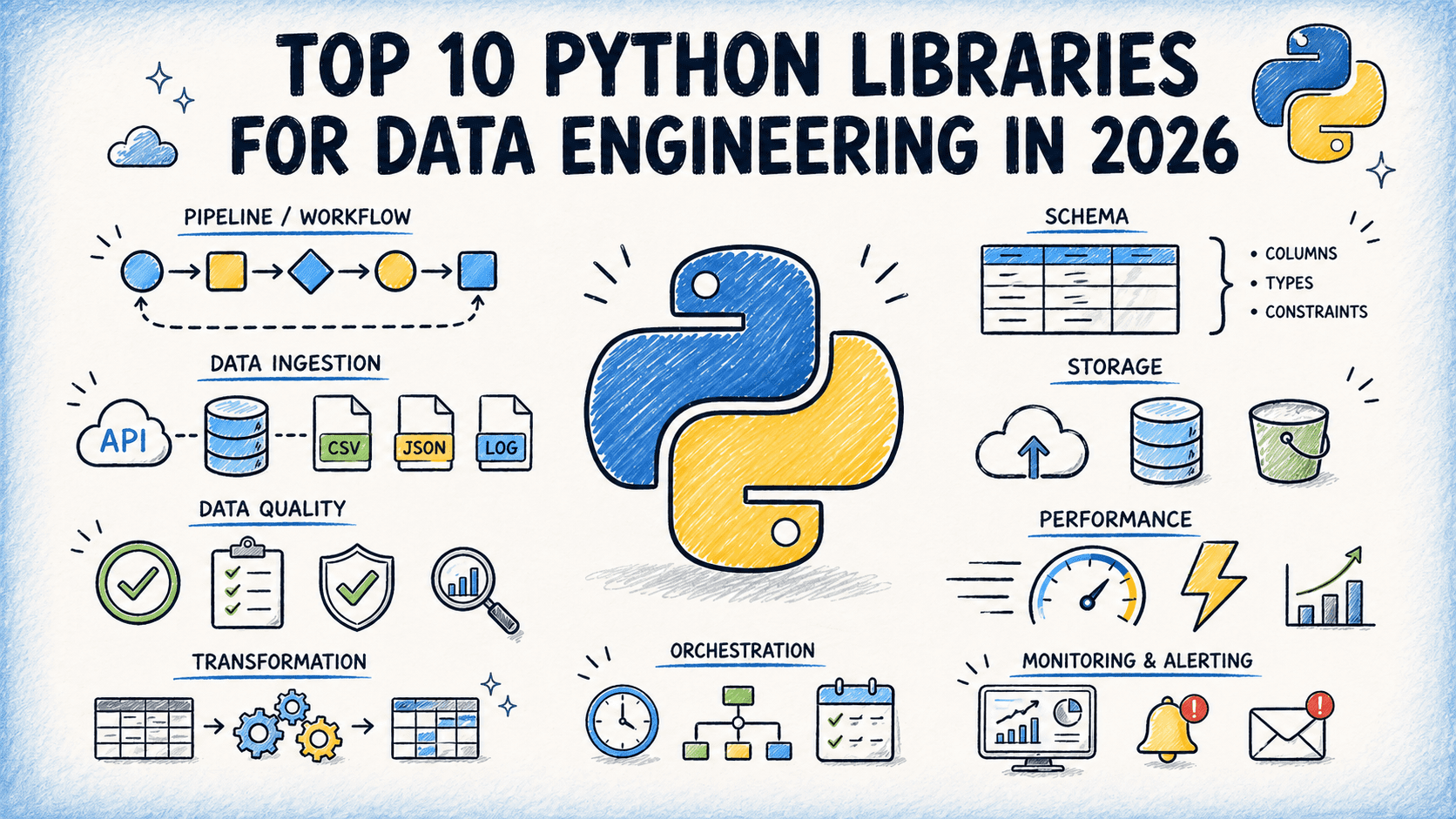
# Introduction
Data engineering has never been more demanding. Pipelines are expected to be faster, more reliable, and easier to maintain — all while the volume and variety of data keeps growing. Most data engineers have their go-to stack, but the Python ecosystem has expanded well beyond the usual suspects, and some of the most useful tools for the job are still flying under the radar.
In this article, we'll walk through Python libraries organized around four areas that eat up the most time in data engineering work:
- Pipeline orchestration and workflow management for building reliable, observable data flows
- Data ingestion and format handling for connecting to diverse sources efficiently
- Data quality and schema management for keeping your pipelines honest
- Storage, serialization, and performance for moving data fast and storing it smart
We'll also point you to a learning resource for each library so you can go from reading to building as quickly as possible. If you're looking to replace a clunky part of your current stack or just curious what else is out there, hopefully a few of these earn a spot in your toolkit.
# Pipeline Orchestration and Workflow Management
// 1. Scheduling and Monitoring Pipelines with Prefect
Scheduling and monitoring data pipelines is painful when your orchestrator gets in the way. Prefect is a modern workflow orchestration library that makes it easy to define, schedule, and observe data pipelines in pure Python, without heavy infrastructure setup.
Here's a list of features that make Prefect useful:
- Lets you decorate ordinary Python functions to turn them into observable, retryable pipeline components with minimal boilerplate
- Provides a clean UI for monitoring runs, inspecting logs, and diagnosing failures in real time, without requiring a separate database or cluster to get started
- Supports automatic retries, caching, concurrency limits, and parameterization out of the box, covering most production needs before you ever write custom logic
Prefect Foundations | Learn Prefect covers all you need to start orchestrating workflows with Prefect.
// 2. Managing Safe SQL Transformations Across Environments with SQLMesh
Managing SQL transformations, testing them, and deploying changes safely across environments is one of the messiest parts of data engineering. SQLMesh is an open-source data transformation framework that extends the ideas behind dbt with semantic understanding of your models and true CI/CD for SQL pipelines.
Here's what SQLMesh offers:
- Understands the full lineage and semantics of your transformation DAG, enabling it to determine exactly which models need to be rebuilt after a change rather than rerunning everything
- Supports virtual environments for models, so you can test changes on a subset of production data without copying entire tables or breaking running pipelines
- Runs on multiple execution engines including DuckDB, Spark, BigQuery, Snowflake, and Trino
SQLMesh Quickstart Guide walks you through setting up a multi-environment transformation project from scratch.
# Data Ingestion and Format Handling
// 3. Building Connector-Free Data Ingestion with dlt
Building connectors and ingestion scripts from scratch is repetitive work. dlt (data load tool) is an open-source Python library that lets you build data ingestion pipelines from any source to any destination with very little code.
Key features that make dlt worth exploring:
- Auto-generates schemas from your data and evolves them automatically as upstream sources change
- Handles incremental loading, deduplication, and merge strategies
- Ships with a growing library of verified sources and destinations that plug in with a few lines of Python
Introduction to dlt in the official docs walks you through building your first ingestion pipeline.
// 4. Processing Real-Time Streams with Bytewax
Building real-time data processing pipelines in Python typically means either heavyweight Flink or Spark Streaming setups or writing low-level Kafka consumer loops. Bytewax is a Python stream processing framework built on Rust that brings a dataflow programming model to streaming pipelines with a clean, native Python API.
Features that make Bytewax useful:
- Defines stateful stream processing logic in pure Python using a functional dataflow API
- Supports windowing, stateful operators, and recovery from failures out of the box, covering the most common real-time aggregation and enrichment patterns
- Integrates with Kafka and Redpanda as input/output connectors, making it a practical lightweight alternative to Flink for teams that want Python-native stream processing
Bytewax Quickstart in the official docs builds a complete streaming pipeline in under fifty lines of Python.
// 5. Scaling Distributed Large-Scale Batch Processing with PySpark
When datasets grow beyond what a single machine can handle, you need a distributed execution engine. PySpark is the Python API for Apache Spark, the industry-standard framework for large-scale batch and streaming data processing across clusters.
Features that make PySpark essential at scale:
- Distributes computation across a cluster automatically
- Provides a DataFrame API that mirrors pandas idioms while executing lazily across partitions, and a SQL interface for teams that prefer writing queries over code
- Integrates with the broader Hadoop and cloud ecosystem — HDFS, S3, Delta Lake, Hive, Kafka — making it a natural fit for organizations with existing data infrastructure
PySpark Getting Started Tutorial in the official docs is the clearest entry point for understanding the distributed programming model.
# Data Quality and Schema Management
// 6. Validating Pipelines and Generating Data Docs with Great Expectations
Data quality issues that slip into production are hard to debug and expensive to fix. Great Expectations is a Python library for defining, documenting, and validating data quality rules across your pipelines.
Here's what Great Expectations offers:
- Lets you write human-readable "expectations" like
expect_column_values_to_not_be_nullthat double as both tests and documentation for your datasets - Generates data docs from your expectations suite, giving stakeholders visibility into data quality without needing to read code
- Integrates with Airflow, Prefect, Spark, and SQL-based data warehouses, so you can embed validation checkpoints at any stage of a pipeline
Quickstart | Great Expectations and Create Expectations in the official docs are both useful to get your first expectations suite running.
// 7. Enforcing Schemas at the Function Level with Pandera
Catching schema violations before they propagate through a pipeline is much cheaper than debugging corrupt data downstream. Pandera is a statistical data validation library that brings type-hinting and schema enforcement to pandas and Polars DataFrames.
Features that make Pandera useful:
- Lets you define schemas that specify expected data types, value ranges, nullability, and statistical properties for each column, then validates DataFrames against them at runtime
- Integrates with Python type annotations, so schemas can be enforced as function argument and return type checks using
check_typesdecorators — keeping validation right next to your transformation logic - Works with Spark and Dask in addition to pandas and Polars, meaning you can reuse the same schema definitions across different execution engines in the same pipeline
How to Use Pandas With Pandera to Validate Your Data in Python by Arjan Codes covers schema definitions and validation patterns clearly.
# Storage, Serialization, and Performance
// 8. Running In-Process Analytical Queries with DuckDB
Running analytical queries on large files without spinning up a data warehouse is slow and awkward. DuckDB is an in-process analytical database that runs fast OLAP queries directly on Parquet, CSV, and JSON files from within Python.
Features that make DuckDB helpful:
- Executes SQL directly against local files and remote object storage without loading data into a separate system, making it ideal for lightweight ETL and exploration
- Integrates natively with pandas and Arrow, so query results drop into DataFrames instantly and memory is shared rather than copied
- Runs embedded inside your Python process with zero server setup, yet scales to datasets far beyond what pandas can handle in memory
DuckDB Tutorial for Beginners: Installation to First Query and A Guide to Data Analysis in Python with DuckDB are good practical introductions to how DuckDB fits into modern data stacks.
// 9. Transforming DataFrames at High Performance with Polars
Pandas is convenient but hits its limits quickly at scale. Polars is a DataFrame library written in Rust that outperforms pandas on most transformation workloads, with a clean API and true multi-threading.
Here are some features that make Polars stand out:
- Executes operations in parallel across all available CPU cores by default, with no extra configuration
- Supports lazy evaluation via
LazyFrame, allowing Polars to optimize entire query plans before executing, similar to how a query planner works in a database engine - Handles datasets larger than RAM through streaming execution, making it a practical pandas replacement for mid-scale ETL without reaching for Spark
Python Polars: A Lightning-Fast DataFrame Library and Pandas vs. Polars: A Complete Comparison of Syntax, Speed, and Memory cover using the API and performance characteristics.
// 10. Writing Backend-Agnostic Data Transformations with Ibis
Writing backend-specific SQL or switching between pandas and PySpark for different environments creates fragile, hard-to-port code. Ibis is a Python dataframe library that compiles the same expression code to SQL for 20+ backends, including BigQuery, Snowflake, DuckDB, Spark, and Postgres.
What makes Ibis useful:
- Provides a single, consistent Python API for transforming data regardless of backend — no SQL dialect juggling required
- Uses lazy evaluation, meaning expressions are compiled and executed on the backend engine rather than pulling data into Python, keeping large-scale transformations efficient
- Lets you drop into backend-specific SQL when needed, so you're never blocked by abstraction limits
10 minutes to Ibis in the official tutorials is the quickest way to get started.
# Summary
These Python libraries address real challenges you'll face in data engineering work. To summarize, we covered useful libraries for orchestrating workflows, ingesting data from diverse sources, enforcing data quality, running fast analytical queries, and managing transformations safely across environments.
| LIBRARY | PRIMARY USE CASE | BEST FOR |
|---|---|---|
| Prefect | Workflow orchestration | Scheduling, retries, and monitoring pipeline runs |
| SQLMesh | SQL transformation management | Safe deploys and environment isolation for SQL models |
| dlt | Data ingestion | Building source-to-destination pipelines with minimal code |
| Bytewax | Stream processing | Real-time, stateful pipelines on Kafka/Redpanda in Python |
| PySpark | Distributed batch processing | Petabyte-scale ETL and transformations across clusters |
| Great Expectations | Pipeline data validation | Writing, documenting, and reporting on data quality rules |
| Pandera | Schema enforcement | Validating DataFrame schemas inline with transformation code |
| DuckDB | In-process OLAP queries | Running SQL on local files and object storage without a warehouse |
| Polars | Fast DataFrame transforms | Multi-threaded, out-of-core pandas replacement for mid-scale ETL |
| Ibis | Backend-agnostic transforms | Writing one DataFrame API that runs on 15+ SQL backends |
Happy data engineering!
Bala Priya is a developer, educator, and technical writer based in India. She writes about programming, data science, machine learning, and AI, with a focus on making complex technical ideas practical and approachable. She creates tutorials, how-to guides, and deep dives that help developers build, solve problems, and understand complex technical concepts. Her technical interests include LLM applications, agentic AI, graph algorithms, computer vision, explainable AI, and ML systems. When she’s not writing or coding, Bala is usually reading classic literature, epic fantasy, or speculative fiction... with a cup of coffee close by. She also enjoys talking about books, learning new things, and sharing what she learns with the developer community.