


Who Pays for AI Data Centers?
The fight is usually framed as whether data centers get built. The harder question underneath it is "who pays and who decides?" The costs are intertwined.

Introduction
John Steinbach has lived in his Manassas, Virginia, home for nearly 40 years, and in January 2026 he opened an electricity bill for \$281, up from roughly \$100 the month before. "It's just so far beyond any bill that I've ever had," he told Consumer Reports. What worries him is where rates go next, as more AI data centers plug into the grid around him.
He has plenty of company. A March 2026 Gallup poll found that seven in 10 Americans oppose building AI data centers in their area, 48% of them strongly, with majorities opposed among Democrats, Republicans, and independents alike.
Local opposition disrupted about 120 projects in the first half of 2026, according to Data Center Watch, including at least 45 projects worth roughly \$68 billion stalled in the second quarter alone.
Around 379 US jurisdictions have adopted moratoriums or barred data centers outright. Indianapolis voted 23–1 in August to bar new construction through 2027, and Charlotte paused approvals for 150 days after a city survey found 78% opposition. Brookings reports that candidates in both parties now run ads against the facilities.
The fight is usually framed as whether data centers get built. The harder question underneath it is who pays and who decides. The costs land locally and soon. The benefits land regionally or nationally, and later. The rules for splitting them were written before AI-scale demand existed.
What follows looks at the contentious issue of data centers from three important angles: the strongest case from critics, the strongest case from industry, and where the evidence lands.
Why AI Changed the Math
Traditional cloud data centers were built around general-purpose servers whose load rises and falls with user traffic. AI clusters pack GPUs far more densely, throw off more heat per rack, and during training runs draw power around the clock. That changes what a single campus asks of the local grid and water system.
U.S. data centers used about 176 terawatt-hours in 2023, roughly 4.4% of the country's electricity, according to a Lawrence Berkeley National Laboratory report prepared for the Department of Energy. The growth ahead is the contested part.
Bloom Energy's January 2026 power report projects U.S. data center IT load nearly doubling, from about 80 gigawatts in 2025 to about 150 gigawatts in 2028. That is a company forecast, and Bloom sells on-site power systems, so it has a stake in the answer.
The same report points to a legitimate bottleneck. Utilities expect to deliver power 1.5 to 2 years later than developers plan for. Developers, for their part, expect roughly a third of data centers to run entirely on on-site power by 2030. When the grid can't keep pace, companies build their own power plants.
Electricity Bills: Who Pays for the Next Grid
The concern starts with one market. PJM, the grid operator serving 13 states and Washington, D.C., runs auctions for capacity, which pays power plants to be available when demand peaks.
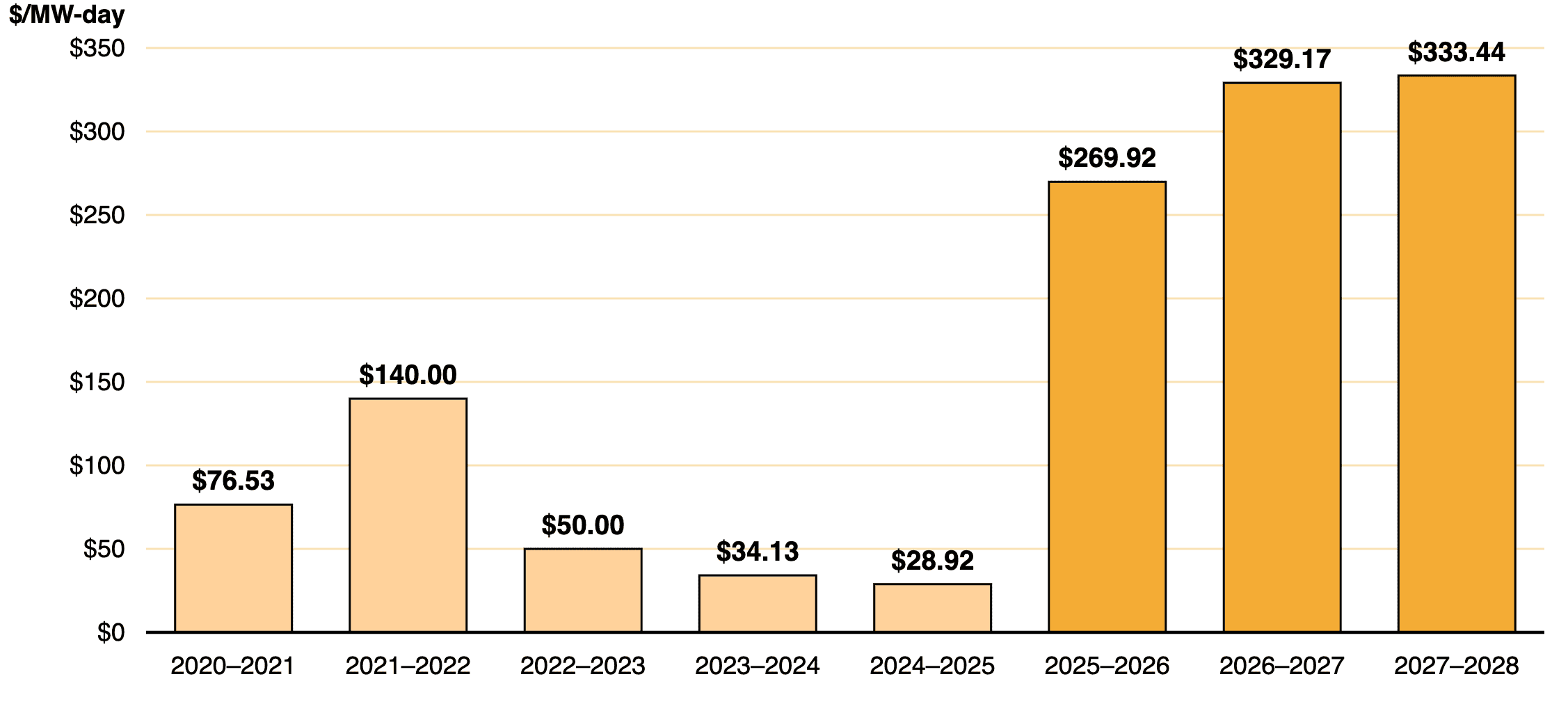
The clearing price went from \$28.92 per megawatt-day for 2024/25 to \$269.92 for 2025/26, then hit the price cap in the next two auctions at \$329.17 and \$333.44. PJM's independent market monitor attributed 63% of the 2025/26 increase, about \$9.3 billion, to data center load.
Other numbers point in the same direction. Virginia residential prices rose about 13% over 12 months, per EIA data. Nearly three-quarters of Virginia voters blamed data centers in a January 2026 survey from Global Strategy Group and the Chesapeake Climate Action Network Action Fund, an environmental advocacy group.
Looking ahead, a peer-reviewed modeling study from NC State, Carnegie Mellon, and two other universities projects wholesale prices 6% to 29% higher nationally by 2030 than in a world without data center growth, and up to 57% higher in the hardest-hit regions. Those are modeled wholesale prices, not retail bills.
The industry's case is that big customers usually lower rates. An Electric Power Research Institute study of 2015 to 2024 found that each doubling of data center capacity came with average retail prices 3.5% lower, because large, steady loads spread a utility's fixed costs across more sales.
An Amazon-funded study by the consultancy E3 found Amazon's payments in four utility territories met or exceeded the cost of serving its data centers, leaving about \$3.4 million in net surplus per site on average. A separate E3 report funded by the Data Center Coalition puts load growth's share of the 2025/26 PJM increase at about 50%, well under the monitor's figure. The free-market Institute for Energy Research found no statistically significant correlation between a state's data center count and its prices.
The evidence lands on "not yet." Rutgers' New Jersey State Policy Lab found no statistically significant effect on bills at the utility level through 2024, and added that "'not yet' is not the same as 'nothing to worry about.'"
The historical benefit depended on spare grid capacity. If the grid is built for demand that never shows up, the fixed costs involved in the grid's capacity increase will end up being spread across a smaller number of people. Other costs are climbing too: Berkeley Lab's 2026 price-trends update points to transmission and distribution spending on hardening, replacement, and expansion. So the useful question is less whether data centers have raised bills so far and more who pays for the next round of inevitable grid expansion.
Water: National Totals, Local Stress
Water-cooled data centers can consume millions of gallons on a single hot summer day, and that number lands hard in dry places. Arizona faces a federal plan that cuts its Colorado River use by 760,000 acre-feet, about 27% to 30%.
That context shaped local votes. Tucson's city council unanimously rejected Amazon's Project Blue in August 2025, and Chandler turned down another proposal 7–0 that December. In Florida, Orange County's vice mayor has proposed a one-year moratorium, citing a projected groundwater shortfall of 96 million gallons a day by 2045.
The viral version of the concern — that each 100-word AI prompt uses about half a liter of water — comes from a GPT-4-era estimate by UC Riverside researchers. Google's own 2025 figure for a median Gemini text prompt is about 0.26 milliliters, roughly five drops, though that counts only water used on site.
The other side points to scale. Berkeley Lab estimates U.S. data centers used about 17.5 billion gallons directly in 2023, a figure that could double or quadruple by 2028. The American Enterprise Institute's Jim Pethokoukis, cited by The Dispatch, puts data centers at under 0.5% of U.S. freshwater and compares Google's Iowa facility to some golf courses.
An Arizona State University report found no rise in central Arizona power suppliers' water use despite data center growth, and agriculture accounts for 72% of the state's water. The fuller count cuts the other way: Berkeley Lab also estimates about 211 billion gallons of indirect use through power generation in 2023.
The evidence says national totals hide local stress. In Botetourt County, Virginia, a planned Google campus could use up to 2 million gallons a day, possibly 8 million, in a county where many residents rely on wells, and the county is putting \$300 million toward a new regional water supply, offset by the project's tax revenue.
Jobs and Tax Revenue: A Strong Case and a Thin One
The tax case is the industry's strongest. Data centers across Northern Virginia paid an estimated \$1.3 billion in property taxes in 2024, and total local revenue they supported topped \$2 billion, according to Chamber of Progress, a tech-industry group.
Quincy, Washington, is the best-case story. In that small farming town, roughly 30 data centers carry an estimated 57% of property taxes. That base has helped pay for a \$120 million high school, a hospital, new police and fire stations, and a \$30 million water reuse facility built with Microsoft, according to CNN and KOMO News.
Texas industry figures cited by the Texas Tribune claim 61,060 direct jobs and \$3.5 billion in state and local taxes in 2023, and company officials say a proposed \$10 billion campus would bring \$50 million a year to Lacy Lakeview, a town of about 7,000.
Even Virginia's legislative auditors ranked the state's data center tax exemption as its second-most productive incentive, at \$6.1 million in personal income per \$1 million of forgone revenue.
The jobs case is thinner. A Brookings analysis of about 1,500 facilities found that a county's first large data center adds on the order of 100 to 200 jobs over a decade, with no change in wages.
Incentive thresholds reflect that. Texas grants sales tax exemptions to facilities of at least 100,000 square feet that create 20 jobs; Maryland asks for five jobs and \$2 million in investment in its Tier 1 areas. Construction jobs are real, but they end when the building does.
States are adjusting. Governors in Illinois, Massachusetts, Nebraska, Nevada, and Ohio paused or reworked data center breaks this year, and Arizona froze new awards for three years, per the Arizona Capitol Times. Virginia kept its exemption but added a tax of 1.1 cents per kilowatt-hour on data center electricity, running from July 2026 to June 2028 and capped at \$600 million a year.
Air Pollution and On-Site Power: The Memphis Case
Memphis is an outlier, not the norm, but it shows what happens when a company decides it can't wait for the grid. To bring its Colossus 1 supercomputer online in 2024, xAI ran trailer-mounted methane gas turbines in South Memphis, as many as 35 by the Southern Environmental Law Center's count from aerial imaging, near Boxtown, a community with decades of industrial pollution. For Colossus 2 it put turbines just across the state line in Southaven, Mississippi, 46 of them by May 2026.
Classifying the units as "non-road engines" let xAI skip air permits until the EPA's January 2026 rule confirmed that large turbines are stationary sources that need them.
SpaceX, which acquired xAI in February, now runs 69 turbines, won't finish removing the unpermitted ones until July 2027, and is building a permanent 1.2-gigawatt gas plant. The NAACP, represented by the Southern Environmental Law Center (SELC) and Earthjustice, has sued under the Clean Air Act.
The company has allies. In June, the Justice Department intervened on xAI's side, calling the turbines a matter of "national, economic, and energy security."
Third-party tests found the 10 pollutants measured weren't at dangerous levels, though the SELC noted that ozone wasn't tested and the wind blew away from the monitors on both test days. Supporters' underlying argument is speed: grid connections take years, and AI competition moves in months.
The studies disagree. A University of Tennessee, Knoxville analysis of satellite data for TIME found average nitrogen dioxide up 3% after June 2024, with peak concentrations up 79% right around the site and 9% in Boxtown.
University of Memphis researchers, writing in The Conversation, modeled a roughly 1% rise in fine particulate matter and found no significant change in satellite data, while noting their methods couldn't detect several hazardous compounds.
Read together, the average effects look small. But they fall on air that already exceeds federal limits, and they come from a plant that skipped the permitting process built to settle exactly this question. The more common version is quieter: Aurora, Colorado's proposed Trident campus plans 28 diesel backup generators.
Local Control: Who Gets a Say
Much of the backlash is about process as much as impact. Before Applied Digital's \$3.6 billion Louisiana campus was announced as Delta Forge 1, it ran as "Project Lightning" and "Project Pixel," under nondisclosure agreements signed by state senators, the parish assessor, and members of the board that approved the deal, NPR reported. In the same state, Hut 8's \$10 billion project in West Feliciana Parish went ahead without nondisclosure agreements, because the parish president chose to negotiate in the open. Bills to ban such agreements have been introduced in Michigan, Oklahoma, Kentucky, and Ohio, and Pennsylvania Gov. Josh Shapiro has barred the agencies he oversees from signing them.
Zoning can cut residents out just as effectively. In Aurora, Vantage's roughly 500-megawatt Trident campus can be approved administratively with no public hearing, because the zoning already allows data centers. The site sits across from a residential development, and the campus would draw roughly 11 times the power of Denver International Airport.
Local control has limits, and developers test them. Hill County, Texas, passed a moratorium 3–2 in May, then rescinded it two weeks later after a developer sued for more than \$100 million, adopting a checklist instead. Developers of major projects there now have to report expected water use, traffic, noise, and economic effects, and give public notice to nearby residents. Tom Green County dropped its own moratorium plans. Inver Grove Heights, Minnesota, went the other way and passed a moratorium 3–2 in June despite a developer's letter claiming more than \$150 million in damages. Charlotte faces its own version of the choice: staff want to extend the city's pause by up to eleven months, and the council has set a public hearing for Oct. 12 before it votes.
States are also pulling decisions upward. Texas Gov. Greg Abbott ordered an audit of every data center seeking a grid connection in August, then in September halted state permitting for data center projects until the audits finish.
At the legislative level, 14 states had considered moratoriums as of June, according to the Rockefeller Institute, and MultiState counts moratorium bills in 11, most of them facing resistance. Pro-growth voices, including The Dispatch, warn that projects blocked here will move overseas and take the jobs and tax base with them.

The Demand Risk Both Sides Underplay
Critics and boosters share an assumption: that the demand is coming. McKinsey's widely cited estimate puts global data center capital spending at about \$6.7 trillion by 2030, and the case for building tends to take demand at that scale as given. Opponents often treat it as inevitable too.
If it falls short, the cost doesn't vanish. Utilities that build generation and transmission for projects later downsized or canceled still have to recover that money, which means spreading fixed costs over fewer customers. That is why minimum payments and exit terms now sit near the center of the policy debate. Virginia's regulators already require the largest customers to pay for at least 85% of their contracted transmission and distribution demand and 60% of generation demand, whether they use it or not.
Conclusion
Both sides' strongest evidence points the same way. The costs of data centers are mostly local and near-term: capacity charges, water systems, air permits, land. The benefits are mostly regional or national and arrive later. The rules for splitting them predate AI-scale demand. Neither "data centers are ruining everything" nor "opposition is just NIMBY panic" holds up against that record.
The pattern repeats question by question. Studies haven't yet tied data centers to measurably higher residential bills, but the capacity market has already moved. Water use is a sliver of the national total — though much more noticeable locally in raw numbers — and a \$300 million line item in Botetourt County. The tax base is real, and the permanent jobs are few.
The policy tools now moving through statehouses aim at the split itself:
- Large-load tariffs. Virginia's new rate class for customers above 25 megawatts takes effect in January 2027, with minimum-demand payments attached.
- Ratepayer protection laws. Pennsylvania's SB 1114 would put large loads in their own class and make them pay the full incremental cost of the grid upgrades they require, modeled on Oregon's POWER Act.
- Full cost recovery for water. If the pipes outlast the building, the building's owner pays for the pipes.
- Conditional tax breaks. Virginia's per-kilowatt-hour tax is one template for keeping an incentive while recovering some of its cost.
- A pause with conditions. Wisconsin's SB 1061 would bar new data centers until the state creates a planning authority and bans nondisclosure agreements with local governments.
- Disclosure before approval. Developer identity, plus projected power and water use, made public before a vote rather than after.
For anyone watching a proposal near them, one question cuts through most of the rest: if the demand never arrives, who pays for the upgrades?
Data centers will keep getting built. The question is whether the next ones come with a fair bill attached.
Matthew Mayo (@mattmayo13) holds a master's degree in computer science and a graduate diploma in data mining. As managing editor of KDnuggets & Statology, and contributing editor at Machine Learning Mastery, Matthew aims to make complex data science concepts accessible. His professional interests include natural language processing, language models, machine learning algorithms, and exploring emerging AI. He is driven by a mission to democratize knowledge in the data science community. Matthew has been coding since he was 6 years old.