


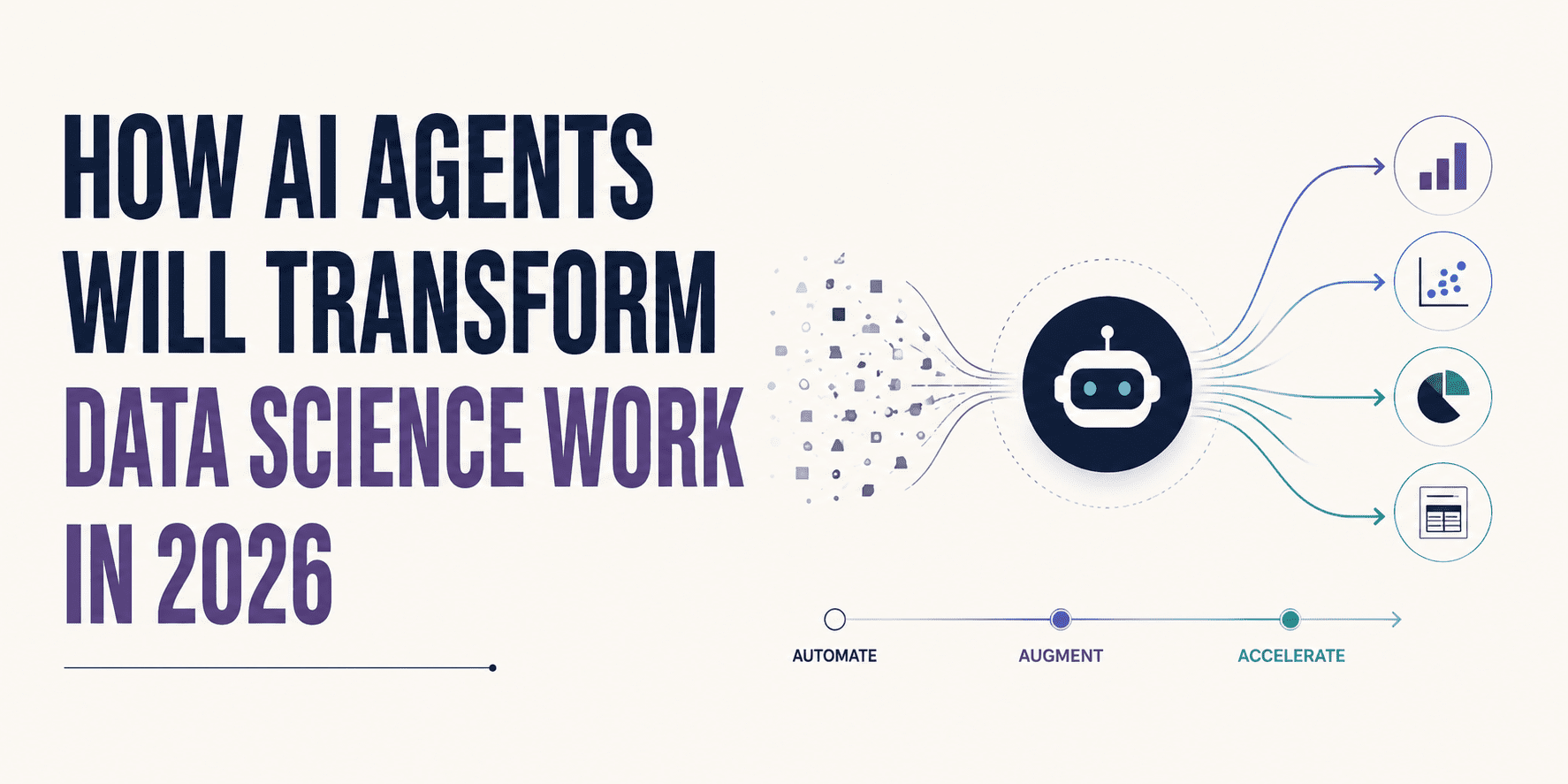
How AI Agents Will Transform Data Science Work in 2026
Discover how AI agents will revolutionize data science in 2026, and learn why they won't replace you but will make you a faster, smarter analyst.
# Introduction
The world of data science moves fast. If you are just starting your journey in 2026, you might feel like you're trying to drink from a firehose. Between mastering Python, understanding cloud computing, and keeping up with the latest machine learning models, it is a lot to handle.
But there's a new trend on the rise that promises to change everything — not by making your job harder, but by making you more capable than ever before. We are talking about the rise of AI agents.
Forget the hype about robots taking over. In 2026, AI agents are expected to become the perfect teammates for data scientists. They won't replace you; they will handle the difficult parts of the job, allowing you to focus on the high-level strategy and problem-solving that machines simply cannot do.
So, what is the future of AI agents in 2026? Let us discuss how these digital peers will reshape the data science workflow.
# What Exactly Is an AI Agent?
Before we look into the future, we need to clarify what we mean by an "AI agent."
Think of a standard AI tool, like a large language model (LLM), as a very smart but passive reference book. You ask it a question, and it gives you an answer. An AI agent, however, is more like a proactive junior colleague. It is an autonomous system that can:
- Understand your data, your code, and your goals
- Reason about the best way to achieve a goal
- Act on its own to complete tasks
- Learn from the results to do better next time
In the context of data science, an agent is not just generating code snippets. It can be tasked with an objective like "improve the accuracy of the customer cancellation model" and then go off to test different algorithms, engineer new features, and validate the results, reporting back to you with its findings.
# Will Data Science Be Replaced by AI in the Future?
This is the million-dollar question for every beginner (and expert) in the field. The short answer is no. In fact, AI agents in data science will likely make human data scientists more valuable, not less.
History has shown us this pattern. Spreadsheets did not replace accountants; they made them faster and allowed them to focus on financial strategy rather than manual addition. Similarly, AI agents will automate the "manual labor" of data science. This includes:
- Data Cleaning: The agent can automatically detect and fix missing values, outliers, and inconsistencies in your dataset.
- Feature Engineering: It can suggest or even create new features from existing data that might improve how your model performs.
- Model Selection and Hyperparameter Tuning: Instead of you spending days running tests, an agent can systematically try dozens of model types and settings to find the best performer.
The human data scientist's role changes from being a doer of tasks to a director of strategy. You define the business problem, provide the context, and evaluate the results. The agent handles the heavy lifting. The data science job market in 2026 will prize professionals who can manage and collaborate with these AI agents, blending technical oversight with business competence.
# What Is the Trend in Data Science in 2026? Shifting to Agentic Workflows
If 2023 was about generative AI writing text and 2024 was about generating code, then 2026 is the year of the "agentic workflow."
Imagine a typical project. In the past, you might spend 80% of your time just getting the data ready (the famous "data wrangling"). In 2026, you will simply hand your messy dataset to an agent with instructions like, "Clean this data according to standard practices for time-series analysis, and document every step you take."
This shift changes the entire speed of work. Here's how a trendsetting data science workflow might look in 2026:
- Problem Definition (You): You meet with stakeholders to understand the business need.
- Orchestration (You and Agent): You task a "Project Manager Agent" with the high-level goal. This agent then breaks the project down into subtasks and delegates them to specialized agents (e.g. a "Data Cleaning Agent," an "EDA Agent," a "Modelling Agent").
- Execution (Agents): The specialized agents work in parallel, handling data preparation, analysis, and initial modelling. They log their progress, flag any issues (like data quality problems), and store their results.
- Review and Refinement (You): You review the agent's report, the generated code, and the candidate models. You provide feedback, ask for a different approach, or accept the results.
- Deployment and Monitoring (You and Agent): Once a model is approved, a "Deployment Agent" packages it and puts it into production, setting up dashboards to monitor its performance and alert you if it starts to throw errors.
This is the logical advancement of tools like AutoML and ChatGPT, combined into a cohesive, autonomous system.
# What Will AI Be Like in 2026? Becoming a Collaborative Partner
So, what will AI be like in 2026? It will be less of a tool and more of a partner. For a beginner data scientist, this is great news. Instead of being blocked for hours by a syntax error, you will have an agent that can not only fix the error but also explain why it happened, helping you learn. Instead of feeling lost in a sea of algorithms, you will have a reasoning partner that can suggest the best path forward based on the details of your data.
This changes the skills required to succeed. While you still need to understand the fundamentals of statistics and machine learning, your most important skills will become:
- Critical Thinking: Can you tell if the agent's results make sense in a business context?
- Communication: Can you clearly define problems for your AI agents to solve?
- Judgment: Which agent-generated solution is truly the most ethical, fair, and robust?
# Conclusion
The rise of AI agents in 2026 will not spell the end for data scientists. Instead, it marks the beginning of a powerful partnership. By automating the repetitive and technical tasks, AI agents will free up human creativity to focus on the bigger picture — like asking the right questions, innovating new solutions, and driving real business impact.
As you build your skills, focus on becoming the director of this group. Learn how to speak the language of data, understand the principles, and most importantly, learn how to lead your new AI teammates. The future of data science is not human or machine; it is human and machine, working together.
References and Further Reading
- Large Language Models and How They Function
- Automated Machine Learning (AutoML)
- Learn More About Data Wrangling
Shittu Olumide is a software engineer and technical writer passionate about leveraging cutting-edge technologies to craft compelling narratives, with a keen eye for detail and a knack for simplifying complex concepts. You can also find Shittu on Twitter.