

NotebookLM for the Creative Architect
If you are looking to optimize your creative and productivity workflows, here are the five features in NotebookLM that matter most right now.
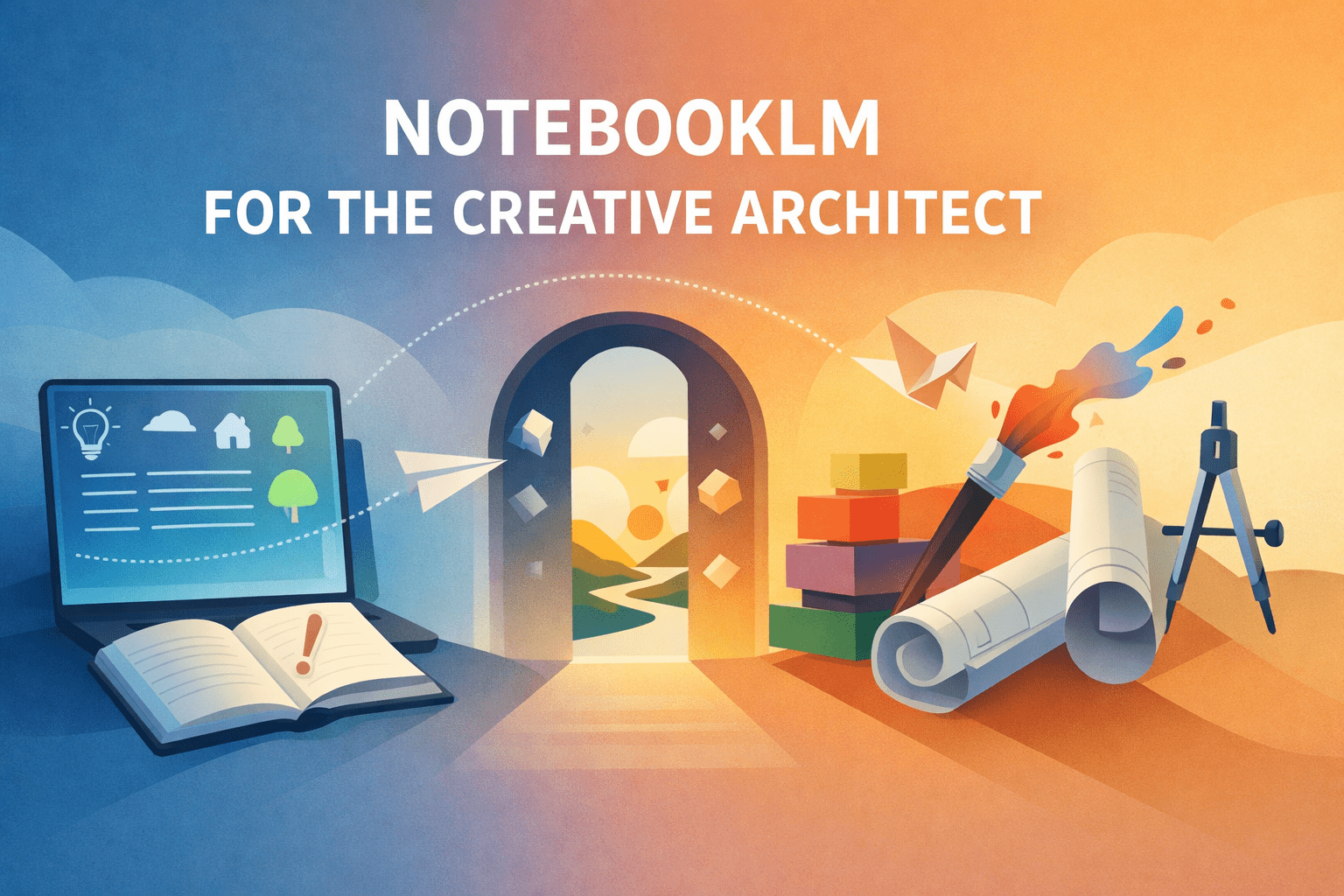
Image by Editor
# Introduction
NotebookLM has evolved fundamentally. Throughout late 2025 and early 2026, it transformed from a smart, source-grounded notepad into a full-fledged multimodal studio for deep thinking, research, and storytelling. For creative architects — professionals who design complex systems, narratives, experiences, or products — this shift is noteworthy. The tool now supports the entire creative project lifecycle, moving fluidly from initial discovery to high-fidelity presentation.
If you are looking to optimize your creative and productivity workflows, here are the five features in NotebookLM that matter most right now.
# 1. Deep Research: The Exploration Engine
The introduction of Deep Research moves NotebookLM from a static your-documents-only assistant to an autonomous research partner. Instead of merely querying manually uploaded files, you can deploy Deep Research to scour the web, discover relevant new sources, reconcile contradictions, and compile citation-backed reports.
The early stages of any creative project are research-heavy and time-consuming. Deep Research automates the tedious parts of the discovery phase by importing findings directly into your notebook. This means new web sources become part of your grounded corpus, powering subsequent chats, mind maps, and generated content. By pruning weak sources and steering the agent, you systematically build a high-quality knowledge base tailored perfectly to your design intent with minimal friction.
# 2. Mind Map and Discovery: Visualizing Conceptual Spaces
For practitioners who think in systems, workflows, and relationships, linear text is rarely enough. The interactive Mind Map feature automatically visualizes the core topics and contextual relationships hidden within your notebook's sources. By clustering related passages and documents into navigable nodes, the Mind Map acts as an AI-generated mirror of your existing thinking.
When managing large bodies of research or mapping out an intricate product ecosystem, it’s easy to lose sight of the bigger picture. The Mind Map allows you to identify conceptual gaps, overlapping constraints, and under-explored themes at a glance. Because it is natively integrated with the chat and Studio panels, you can effortlessly move from a high-level systems view to concrete execution, using a specific map branch to generate an outline, a user study guide, or a strategic brief.
# 3. Visual Studio: Auto-Drafting Infographics and Slide Decks
Translating complex internal structures into external narratives is a core requirement for any creative architect. NotebookLM’s Studio panel features a robust visual production environment capable of turning your curated research directly into infographics and slide decks. With recent updates, this includes prompt-based slide editing ("make slide 3 more concise") and native PPTX export for seamless handoffs.
The Visual Studio drastically reduces the time between understanding a concept and communicating it to stakeholders. You can rapidly generate multiple variations of a presentation — such as a technical deep dive for engineers and an executive vision deck for leadership — anchored cleanly to the same source material to ensure alignment. The frictionless PPTX export means the AI serves as your fast first-draft design engine, allowing you to finalize the polish in tools like PowerPoint.
# 4. Audio and Cinematic Video Overviews: Rapid Narrative Prototyping
If you've been using NotebookLM for any amount of time, you've likely seen the Audio Overview feature, which generates engaging, podcast-style, multi-speaker conversations that synthesize the key ideas within your notebook. Cinematic Video Overviews take this a step further, turning your documents into fluid, animated, narrative-led videos. These overviews go beyond basic summaries, offering customizable tones, pacing, and detailed explorations of the material.
Creative architects frequently need to internalize complex material and test narrative flows before committing to a final artifact. Listening to an audio overview allows for an "embodied understanding" of pacing and emphasis that reading cannot match. Furthermore, these features serve as reusable narrative scaffolds. A Cinematic Video Overview can be instantly utilized as a mood-setting opener for a client workshop or internal presentation, supporting iterative narrative design without constant manual rewriting.
# 5. High-Capacity, Multimodal Notebooks: The Ultimate Knowledge Hub
NotebookLM’s underlying canvas has received a massive expansion. Powered by Gemini 3, it now boasts a 1-million-token context window and the ability to process a massive variety of inputs, including Word documents, spreadsheets, and OCR-scanned images. Furthermore, the robust Data Tables securely structures qualitative descriptions into easily exportable comparison matrices.
You no longer have to carefully trim the context you feed into your workspace. Creative architects can upload an entire project history — including research papers, timelines, annotated diagrams, and transcripts — into a single conversational context without losing fidelity. Data Tables are particularly powerful for complex decision-making; you can ask the notebook to evaluate competing options from your research and immediately receive a structured matrix ready for export to Google Sheets, providing remarkable clarity for evaluating concept options and mapping stakeholder needs.
# Wrapping Up
Individually, each of these NotebookLM features provides a targeted productivity boost. Together, they form an end-to-end knowledge workflow tailor-made for the modern creative architect. By utilizing Deep Research to build a corpus, illuminating connections via Mind Maps, rapidly structuring decisions with Data Tables, and communicating narratives through Visual Studio and Cinematic Video Overviews, practitioners can operate more efficiently and creatively than ever before. This integrated pipeline positions NotebookLM not just as a data synthesis app, but as the premier hub for designing complex creative systems.
Matthew Mayo (@mattmayo13) holds a master's degree in computer science and a graduate diploma in data mining. As managing editor of KDnuggets & Statology, and contributing editor at Machine Learning Mastery, Matthew aims to make complex data science concepts accessible. His professional interests include natural language processing, language models, machine learning algorithms, and exploring emerging AI. He is driven by a mission to democratize knowledge in the data science community. Matthew has been coding since he was 6 years old.