


Powerful Local AI Automations with n8n, MCP and Ollama
The ultimate goal is to run these automations on a single workstation or small server, replacing fragile scripts and expensive API-based systems.
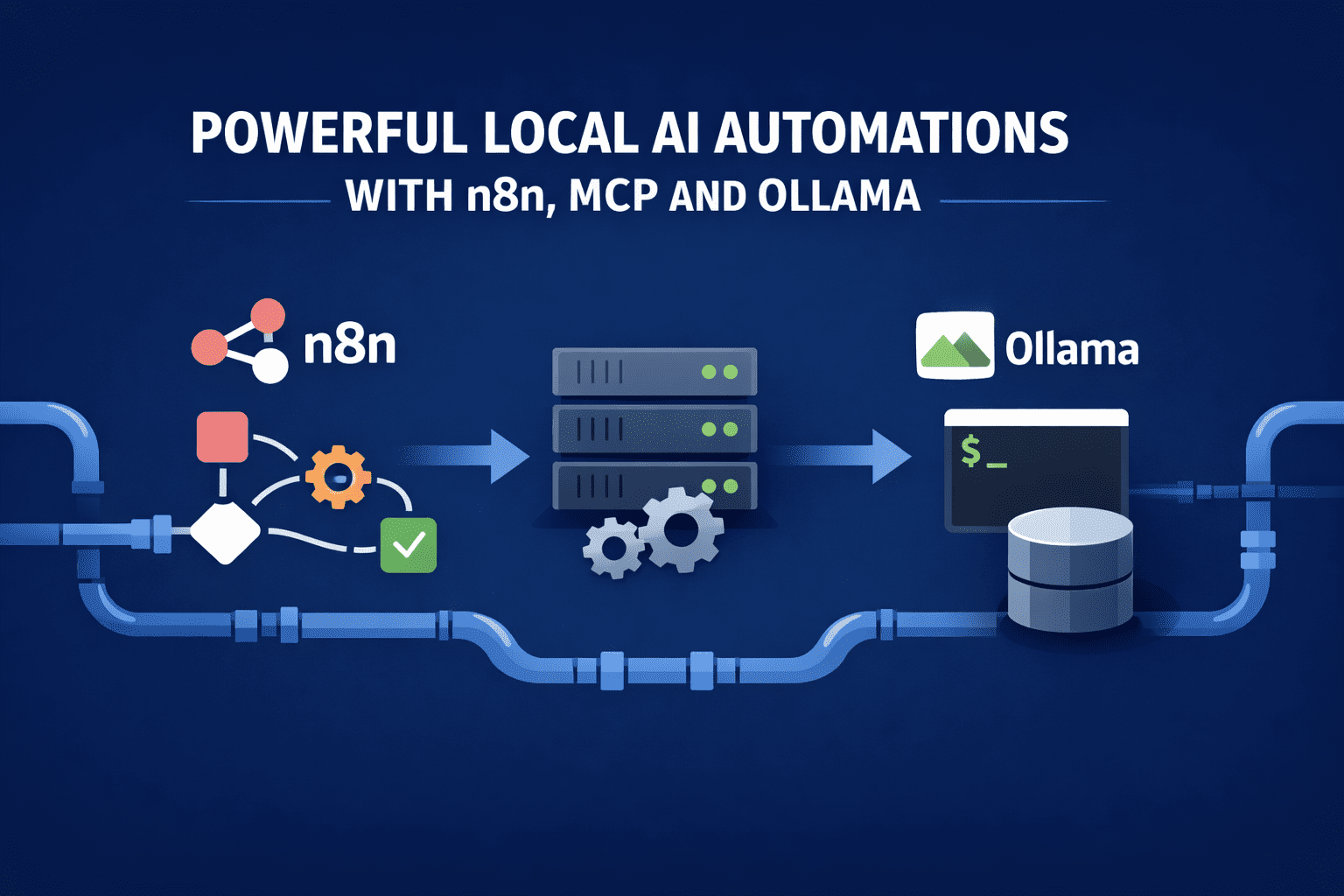
Image by Editor
# Introduction
Running large language models (LLMs) locally only matters if they are doing real work. The value of n8n, the Model Context Protocol (MCP), and Ollama is not architectural elegance, but the ability to automate tasks that would otherwise require engineers in the loop.
This stack works when every component has a concrete responsibility: n8n orchestrates, MCP constrains tool usage, and Ollama reasons over local data.
The ultimate goal is to run these automations on a single workstation or small server, replacing fragile scripts and expensive API-based systems.
# Automated Log Triage With Root-Cause Hypothesis Generation
This automation starts with n8n ingesting application logs every five minutes from a local directory or Kafka consumer. n8n performs deterministic preprocessing: grouping by service, deduplicating repeated stack traces, and extracting timestamps and error codes. Only the condensed log bundle is passed to Ollama.
The local model receives a tightly scoped prompt asking it to cluster failures, identify the first causal event, and generate two to three plausible root-cause hypotheses. MCP exposes a single tool: query_recent_deployments. When the model requests it, n8n executes the query against a deployment database and returns the result. The model then updates its hypotheses and outputs structured JSON.
n8n stores the output, posts a summary to an internal Slack channel, and opens a ticket only when confidence exceeds a defined threshold. No cloud LLM is involved, and the model never sees raw logs without preprocessing.
# Continuous Data Quality Monitoring For Analytics Pipelines
n8n watches incoming batch tables in a local warehouse and runs schema diffs against historical baselines. When drift is detected, the workflow sends a compact description of the change to Ollama rather than the full dataset.
The model is instructed to determine whether the drift is benign, suspicious, or breaking. MCP exposes two tools: sample_rows and compute_column_stats. The model selectively requests these tools, inspects returned values, and produces a classification along with a human-readable explanation.
If the drift is classified as breaking, n8n automatically pauses downstream pipelines and annotates the incident with the model’s reasoning. Over time, teams accumulate a searchable archive of past schema changes and decisions, all generated locally.
# Autonomous Dataset Labeling And Validation Loops For Machine Learning Pipelines
This automation is designed for teams training models on continuously arriving data where manual labeling becomes the bottleneck. n8n monitors a local data drop location or database table and batches new, unlabeled records at fixed intervals.
Each batch is preprocessed deterministically to remove duplicates, normalize fields, and attach minimal metadata before inference ever happens.
Ollama receives only the cleaned batch and is instructed to generate labels with confidence scores, not free text. MCP exposes a constrained toolset so the model can validate its own outputs against historical distributions and sampling checks before anything is accepted. n8n then decides whether the labels are auto-approved, partially approved, or routed to humans.
Key components of the loop:
- Initial label generation: The local model assigns labels and confidence values based strictly on the provided schema and examples, producing structured JSON that n8n can validate without interpretation.
- Statistical drift verification: Through an MCP tool, the model requests label distribution stats from previous batches and flags deviations that suggest concept drift or misclassification.
- Low-confidence escalation: n8n automatically routes samples below a confidence threshold to human reviewers while accepting the rest, keeping throughput high without sacrificing accuracy.
- Feedback re-injection: Human corrections are fed back into the system as new reference examples, which the model can retrieve in future runs through MCP.
This creates a closed-loop labeling system that scales locally, improves over time, and removes humans from the critical path unless they are genuinely needed.
# Self-Updating Research Briefs From Internal And External Sources
This automation runs on a nightly schedule. n8n pulls new commits from selected repositories, recent internal docs, and a curated set of saved articles. Each item is chunked and embedded locally.
Ollama, whether run through the terminal or a GUI, is prompted to update an existing research brief rather than create a new one. MCP exposes retrieval tools that allow the model to query prior summaries and embeddings. The model identifies what has changed, rewrites only the affected sections, and flags contradictions or outdated claims.
n8n commits the updated brief back to a repository and logs a diff. The result is a living document that evolves without manual rewrites, powered entirely by local inference.
# Automated Incident Postmortems With Evidence Linking
When an incident is closed, n8n assembles timelines from alerts, logs, and deployment events. Instead of asking a model to write a narrative blindly, the workflow feeds the timeline in strict chronological blocks.
The model is instructed to produce a postmortem with explicit citations to timeline events. MCP exposes a fetch_event_details tool that the model can call when context is missing. Each paragraph in the final report references concrete evidence IDs.
n8n rejects any output that lacks citations and re-prompts the model. The final document is consistent, auditable, and generated without exposing operational data externally.
# Local Contract And Policy Review Automation
Legal and compliance teams run this automation on internal machines. n8n ingests new contract drafts and policy updates, strips formatting, and segments clauses.
Ollama is asked to compare each clause against an approved baseline and flag deviations. MCP exposes a retrieve_standard_clause tool, allowing the model to pull canonical language. The output includes exact clause references, risk level, and suggested revisions.
n8n routes high-risk findings to human reviewers and auto-approves unchanged sections. Sensitive documents never leave the local environment.
# Tool-Using Code Review For Internal Repositories
This workflow triggers on pull requests. n8n extracts diffs and test results, then sends them to Ollama with instructions to focus only on logic changes and potential failure modes.
Through MCP, the model can call run_static_analysis and query_test_failures. It uses these results to ground its review comments. n8n posts inline comments only when the model identifies concrete, reproducible issues.
The result is a code reviewer that does not hallucinate style opinions and only comments when evidence supports the claim.
# Final Thoughts
Each example limits the model’s scope, exposes only necessary tools, and relies on n8n for enforcement. Local inference makes these workflows fast enough to run continuously and cheap enough to keep always on. More importantly, it keeps reasoning close to the data and execution under strict control — where it belongs.
This is where n8n, MCP, and Ollama stop being infrastructure experiments — and start functioning as a practical automation stack.
Nahla Davies is a software developer and tech writer. Before devoting her work full time to technical writing, she managed—among other intriguing things—to serve as a lead programmer at an Inc. 5,000 experiential branding organization whose clients include Samsung, Time Warner, Netflix, and Sony.