


The Roadmap to Becoming an AI Security Engineer in 2027
From cybersecurity foundations to defending machine learning systems, agentic pipelines, and large language model applications.

The attack surface has changed. Organizations building AI-powered products need security engineers who understand what's actually new here: model theft, training data poisoning, inference attacks, privacy risks from embedding memorization, and the governance requirements that come with deploying these systems at scale.
This created a role that simply didn't exist five years ago. An AI security engineer protects machine learning systems from attacks targeting their data, models, and infrastructure, which involves working across the full lifecycle of an AI product rather than focusing on traditional network perimeters or web application layers.
The market reflects that shift. In one analysis, 28.5% of cybersecurity job postings between October 2025 and March 2026 required AI skills, up from 14.2% in the same period a year earlier. ZipRecruiter puts the average US AI security engineer salary at \$152,773 per year as of August 2026, with the top 10% near \$205,000.
This roadmap covers six steps to get there, starting from prerequisites and moving into specialized practice areas that hiring teams are actively looking for right now.
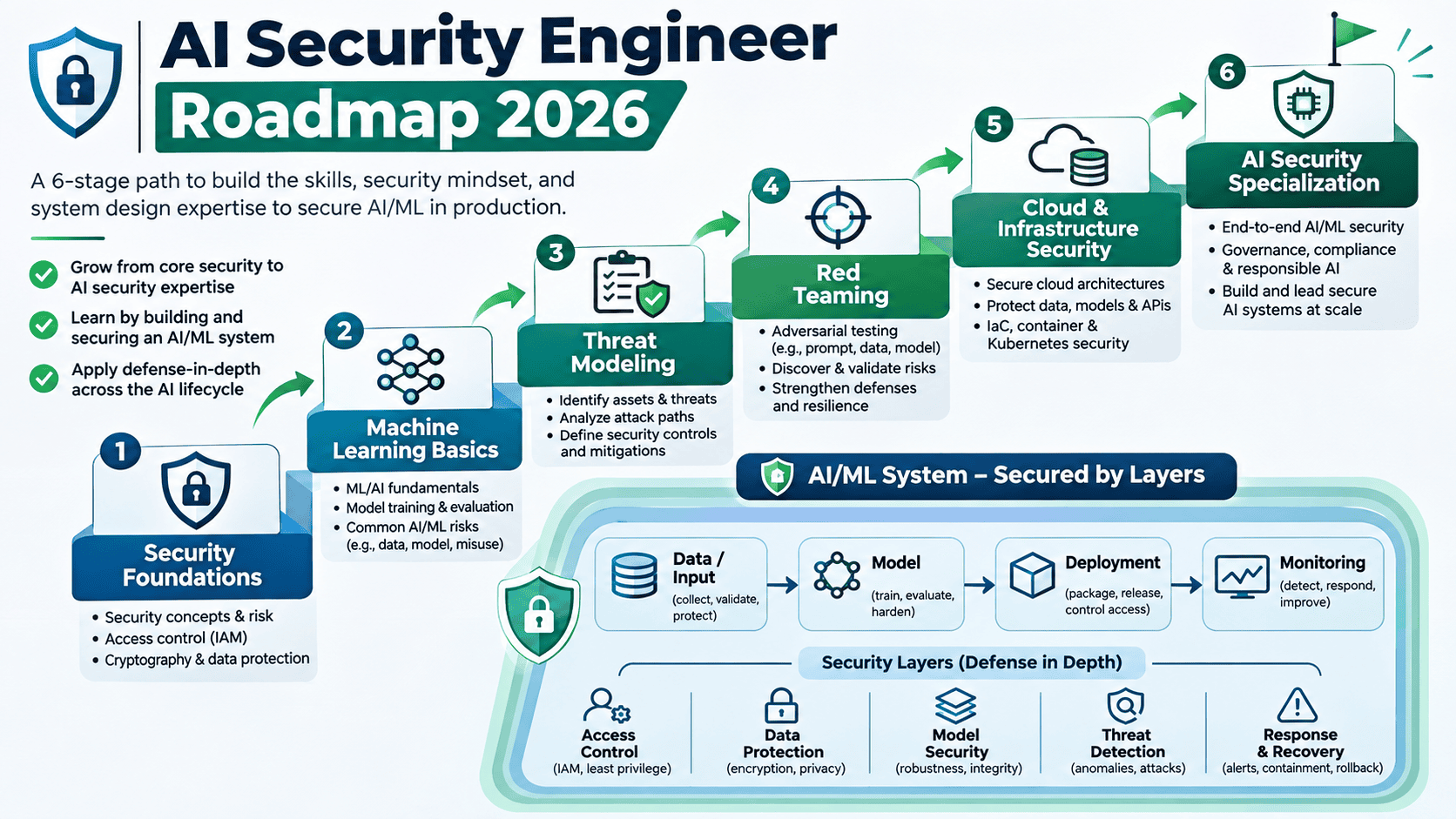
Step 1: Building Core Security and Programming Foundations
There's no shortcut past this step. AI security engineering is a specialization built on top of general security knowledge, so the foundation has to be solid before you can layer AI-specific skills on top.
On the security side, focus on networking fundamentals (TCP/IP, DNS, TLS), operating system internals, authentication and access control, and application security concepts like injection vulnerabilities, insecure deserialization, and broken authorization. These translate directly into AI security work. Many large language model (LLM) and machine learning vulnerabilities are extensions of classic security problems.
On the programming side, Python is non-negotiable. Python, secure coding, API hardening, cloud-native security, and familiarity with machine learning frameworks show up consistently across job descriptions in this field. Focus on writing Python you can actually audit: understand how your code handles untrusted inputs, where injection points live, and how secrets management works in modern applications.
Learning objectives for this step:
- Complete a CompTIA Security+ certification or equivalent to establish a shared vocabulary with hiring managers
- Build a working knowledge of the OWASP Top 10 and how each vulnerability class appears in web and API contexts
- Write at least five Python scripts that interact with APIs, handle authentication, and process data inputs with validation
Resources: TryHackMe, Hack The Box, the OWASP Testing Guide, and Python's official documentation (pay particular attention to the subprocess, hashlib, and secrets modules).
Step 2: Understanding How Machine Learning Systems Work
You can't defend systems you don't understand. Before getting into adversarial machine learning or LLM security, you need a solid mental model of how these systems are built and where they're structurally fragile.
This step doesn't require a PhD in machine learning. What you need is enough depth to understand what a training pipeline looks like, how a model ingests and memorizes data, what inference means in a production context, and how retrieval-augmented generation (RAG) architectures retrieve and inject external content at runtime.
Pay close attention to how LLMs differ from classical machine learning models in terms of their attack surface. LLMs process natural language as input, which means the boundary between "instruction" and "data" is blurry by design. That blurriness is exactly where prompt injection comes from, one of the defining vulnerability classes of this role.
Learning objectives for this step:
- Complete a machine learning fundamentals course focused on supervised learning, model training, and evaluation
- Build a simple RAG application using an open-source LLM to understand retrieval pipelines and embedding storage
- Document the data flow in your RAG build: where does untrusted content enter, and what can it influence?
Resources: fast.ai Practical Deep Learning, LangChain documentation, and Hugging Face Transformers for hands-on model work.
from langchain_community.vectorstores import Chroma
from langchain_openai import OpenAIEmbeddings

# docs: a list of LangChain Document objects loaded earlier (e.g. with a document loader)
# Load and embed documents into a vector store
embedding = OpenAIEmbeddings()
vectorstore = Chroma.from_documents(docs, embedding)
retriever = vectorstore.as_retriever()
This setup is exactly where untrusted documents can inject content. Analyzing this retrieval step is a core AI security engineering task.
Step 3: Learning the AI-Specific Threat Model
AI security engineering is adversarial and technical: you build controls and you try to break them. Step 3 is where you start thinking like an attacker (specifically against AI systems).
The core threat categories to study:
Prompt injection: Direct and indirect prompt injection, where malicious content in retrieved documents or user input overrides system instructions. Think of it as the SQL injection of the LLM era.
Training data poisoning: Manipulating the data a model learns from to influence its outputs in a targeted way. This matters most for models that ingest user-generated content.
Model extraction and theft: Using a series of queries to reconstruct a proprietary model's behavior or steal its capabilities. This is a real commercial and intellectual property risk for organizations deploying fine-tuned models.
Adversarial inputs: Inputs crafted to cause a model to misclassify or behave in unintended ways. This is most relevant for image classifiers and content moderation systems.
Data leakage through memorization: LLMs can memorize and reproduce training data verbatim, including sensitive personal or proprietary information, sometimes without any obvious trigger.
The OWASP Top 10 for LLM Applications is the most structured reference for this threat landscape and should be your primary study document at this stage. Work through each category, understand the attack mechanics, and think about how you'd detect or prevent each one.
Step 4: Developing Hands-On Red Teaming and Defense Skills
The skills that made a good Security Operations Center (SOC) analyst (adversarial thinking, operational context, pattern recognition, understanding of attacker behavior) are exactly what make a good AI security engineer. This step puts that thinking into practice against actual AI systems.
Red teaming AI systems means systematically probing them for vulnerabilities using structured methods. At a minimum, practice these:
- Running prompt injection attacks against LLM applications, including indirect injection through RAG pipelines
- Testing content filters for bypass techniques using encoding, language switching, and role-play framing
- Evaluating guardrail robustness by attempting to elicit restricted outputs through multi-turn conversation
On the defensive side, learn how to implement the controls that counter these attacks. Output filtering, input sanitization, privilege separation for agentic systems, and rate limiting are the basics. More advanced controls include sandboxing tool calls in agentic pipelines, implementing LLM firewalls, and designing least-privilege access patterns for models that interact with external APIs.
# Simple output filter to detect potential data leakage
def check_output(response: str, sensitive_patterns: list) -> bool:
    for pattern in sensitive_patterns:
        if pattern.lower() in response.lower():
            return False  # Flag for review
    return True
This kind of lightweight guardrail is a starting point. Production systems layer multiple detection and filtering approaches on top of each other.
Step 5: Adding Cloud Security and MLOps Depth
AI systems run in cloud environments, which means securing them requires understanding both the AI-specific risks and the underlying infrastructure they run on. The key skills here are MLOps, Kubernetes and container security, Infrastructure as Code (Terraform, Ansible), and cloud security architecture.
At this step, focus on how machine learning models are actually deployed and served in production. Learn how MLOps pipelines work, where the security controls should sit, and how to handle supply chain security for models and their dependencies.
Cloud-specific areas to cover:
- Identity and access management for AI workloads, including least-privilege service accounts
- Securing model registries and artifact stores
- Network segmentation for inference endpoints
- Logging and monitoring for AI-specific threat signals, including unusual query patterns and output anomalies
The Microsoft SC-500 Cloud and AI Security Engineer certification covers many of these areas and is one of the clearer signals right now for demonstrating this skill set to hiring managers. The ISC2 AI Security Certificate is also worth considering if you're building a broader AI security portfolio.
Step 6: Specializing and Engaging with the AI Security Community
The fastest-growing titles in AI security right now are AI Red Teamer, ML Security Engineer, AI Trust and Safety Analyst, and LLM Security Architect, with engineers focused on agentic AI among the most in demand. At this stage, you're picking which of these paths to develop real depth in.
Specialization options at the senior level:
Agentic AI security: As AI agents that autonomously call tools, browse the web, and execute code move into production, securing their permission models and tool access is becoming its own discipline. This is the fastest-moving area in the field right now.
AI governance and compliance: Connecting technical security controls to emerging regulatory requirements, including the EU AI Act and sector-specific AI regulations. This path blends legal and policy understanding with technical depth.
AI red teaming: Building and running structured red team programs specifically for AI systems, often as an internal function at organizations deploying AI at scale.
Engaging with the community accelerates specialization. Follow the MITRE ATLAS framework for AI adversarial tactics, contribute to or participate in AI Village at DEF CON, and keep an eye on the OWASP LLM project mailing list as the threat landscape keeps shifting.
Wrapping Up
This roadmap runs from security fundamentals through machine learning literacy, adversarial thinking, hands-on red teaming, cloud and MLOps depth, and into specialization. Most practitioners estimate four to eight months to reach a job-ready baseline, though the timeline depends heavily on where you're starting from.
The most common entry paths are a security engineer moving into AI workload protection, a cloud security engineer learning AI-specific threats, an application security engineer working on AI features and agents, a detection engineer or SOC analyst moving into AI-enabled defense, or an ML engineer adding serious security depth. If you're coming from one of these backgrounds, you likely have more of the foundation than you realize.
The field is being defined in real time. The practitioners shaping it now, through public research, capture-the-flag competitions, and open-source tooling, are the ones building the reputations that will matter most as it matures.
Vinod Chugani is an AI and data science educator who bridges the gap between emerging AI technologies and practical application for working professionals. His focus areas include agentic AI, machine learning applications, and automation workflows. Through his work as a technical mentor and instructor, Vinod has supported data professionals through skill development and career transitions. He brings analytical expertise from quantitative finance to his hands-on teaching approach. His content emphasizes actionable strategies and frameworks that professionals can apply immediately.