


Open Source vs. Proprietary LLMs: A Decision Framework for 2026
A practical guide to choosing between open-weight and commercial models, built around the four questions that actually determine the right answer for your use case.
"Should we use an open source or proprietary large language model (LLM)?" The answer in 2026 looks very different from what it did eighteen months ago. The capability gap between the two categories has shrunk considerably. Cost dynamics now favor open models at scale but still tilt toward proprietary APIs for low-volume work and rapid iteration. And the practical factors — data privacy, fine-tuning needs, infrastructure capacity, and regulatory compliance — carry more weight than raw benchmark scores in most real-world decisions.
This guide doesn't argue for one category over the other. Both are legitimate, and both are widely deployed in production. The goal is to give data scientists and machine learning engineers a structured framework for making the decision based on what actually matters for their situation, not what generates the most online commentary.
The framework boils down to four questions: What does your data sensitivity require? What's your usage volume? How much do you need to customize the model? And what can your team's infrastructure handle? Working through those four questions will resolve the open-vs-proprietary decision for the vast majority of use cases.
Understanding the Current Model Families
Before we get into the decision framework, here's what each category actually contains in 2026.
The Open-Weight Landscape
"Open source" in the LLM context usually means open-weight. The model weights are publicly available, but the training data, code, and methodology may not be fully disclosed. Licensing terms vary a lot, and some licenses marketed as open source don't meet the Open Source Initiative's formal definition.
Here are the leading open-weight model families in 2026:
Meta's Llama 4 family remains the most influential open-weight series. Llama 4 Scout stands out with a 10 million token context window, the first open model to hit that scale, making it a real contender for long-context document analysis. The Llama license (Meta Community License) permits commercial use but includes restrictions worth reading carefully before deployment.
DeepSeek has established itself as one of the most capable open-weight providers. DeepSeek V3 and its successors benchmark favorably against GPT-4o class models on reasoning and coding tasks. DeepSeek R1 is specifically built for mathematical and logical reasoning, making it the strongest open-weight pick for tasks involving complex multi-step inference. The MIT license is the most permissive of the major open-weight families.
Qwen 3.5 (Alibaba) currently sits at the top of several open-weight leaderboards for overall reasoning and coding. The 235B-A22B mixture-of-experts variant goes toe-to-toe with frontier proprietary models on most standard benchmarks. Apache 2.0 licensing makes it commercially accessible. Qwen 3.5 also leads in multilingual performance, especially for Chinese, Arabic, and other non-English languages.
Mistral contributes a range of efficient open-weight models, with Mistral Small variants punching above their weight class. Smaller Mistral models (Mistral 7B and Mistral Small) carry Apache 2.0 licenses. Mistral's French origin gives it particular relevance for organizations operating under European data governance frameworks, and Mistral Small 4 fits well into GDPR-aligned EU deployment scenarios.
The Proprietary API Landscape
Proprietary models are accessed through managed APIs. No weights are available. The provider handles infrastructure, updates, and scaling.
The leading proprietary models in 2026 include the GPT-5 series from OpenAI, Claude models from Anthropic, and Gemini models from Google. Each has distinct strengths. Claude's 200K token context window is a clear advantage for long-document analysis. GPT-5's ecosystem depth (SDKs, integrations, structured output formats, Assistants API) makes it the lowest-friction choice for teams already building on OpenAI tooling. Gemini integrates tightly with Google Cloud and Vertex AI, which benefits organizations already in that ecosystem.
Proprietary API pricing in 2026 spans a wide range, from \$0.05 per million input tokens for lightweight models up to \$30 per million for frontier-tier models. The mid-tier most commonly used in production (GPT-4o, Claude Sonnet, Gemini Flash) runs between \$1.25 and \$3.00 per million input tokens. Output tokens cost two to four times the input rate.
One big shift in 2026: LLM API pricing has dropped roughly 80% since early 2023, driven by competition from open-weight models and efficiency improvements. Frontier proprietary models still command a 2–5x price premium over equivalent open-weight models accessed through hosted inference providers.
The Performance Reality
Before working through the framework, it helps to understand what the capability gap actually looks like so you can gauge how much it matters for your specific use case.
The big picture: open-weight models have closed 70–90% of the capability gap against frontier proprietary models as measured by standard benchmarks. On specific task categories like coding, structured data extraction, and mathematical reasoning, the best open-weight models match or sometimes exceed proprietary alternatives. The persistent gaps show up in complex multi-step reasoning (where Claude Opus-class models still lead on benchmarks like GPQA Diamond), instruction-following consistency at scale, and performance in low-resource languages.
Here's the practical takeaway: for about 80% of data science use cases (text classification, summarization, structured data extraction, retrieval-augmented generation over internal documents, code generation assistance), well-chosen open-weight models deliver results that are functionally indistinguishable from proprietary APIs. For the remaining 20% — which includes nuanced long-form reasoning, complex agentic chains, or applications where output reliability at the tail end matters a lot — proprietary frontier models still hold a measurable edge.
Bottom line: evaluate models on your actual tasks, not on published leaderboard scores for tasks you'll never run in production.
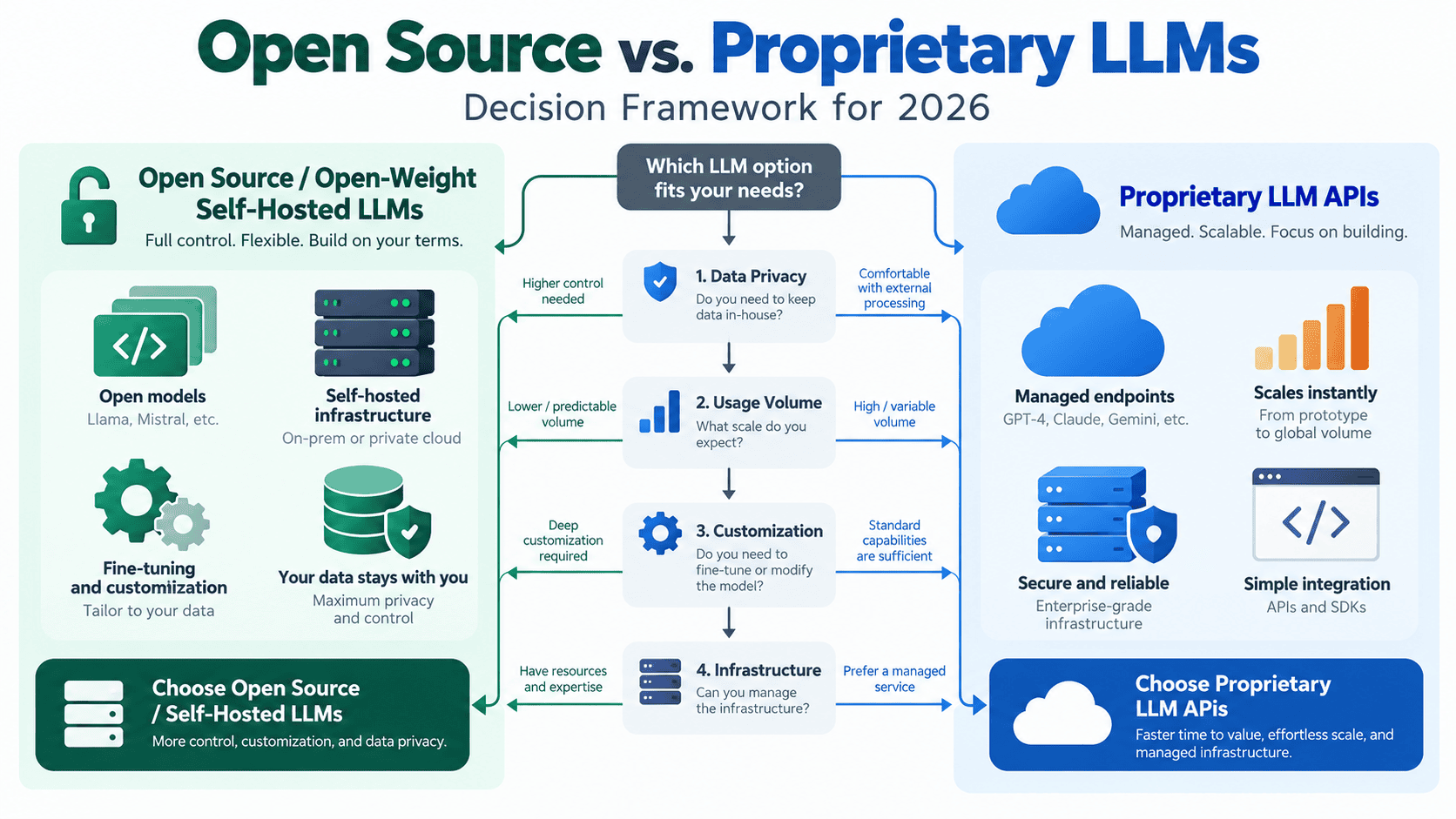
The Four-Question Decision Framework
Question 1: What Does Your Data Require?
This is the question that settles the debate most often, and it has nothing to do with cost or capability. If your use case involves data that cannot legally or contractually leave your environment, open-weight self-hosting isn't just an option. It's a requirement.
The categories that trigger this include medical records and clinical notes (HIPAA in the US, similar regulations elsewhere), personal financial information (PII, transaction data, account details), proprietary business data under NDA or confidentiality agreements, government and defense data with classification or sovereignty requirements, and EU personal data under GDPR when the API provider's data processing arrangements don't satisfy your legal team.
If you fall into any of these categories, the decision branches straight to open-weight self-hosting or a private cloud deployment. Cost and capability comparisons take a back seat because compliance isn't negotiable.
If your data can be sent to a third-party API provider (most general business text, public data, anonymized datasets), move on to Questions 2 through 4.
Question 2: What Is Your Usage Volume?
The cost math for open-weight vs. proprietary APIs isn't linear. It depends heavily on scale.
At low volume (under 1 million tokens per month), proprietary APIs are more cost-effective once you factor in the infrastructure and engineering overhead of running your own models. A small prototype or internal tool at this scale doesn't justify the GPU spend, the MLOps work, or the security hardening needed to run your own serving stack.
At medium volume (roughly 1–10 million tokens per month), the picture gets more nuanced. Proprietary APIs are still operationally simpler, but the monthly bill starts adding up. Open-weight models accessed through hosted inference providers (Together AI, Groq, Replicate, and others) offer a middle path: open-weight quality and pricing without the infrastructure headache. A hosted Qwen 3 or DeepSeek V3 typically costs \$0.20–\$0.60 per million tokens blended, compared to \$1.25–\$3.00 for mid-tier proprietary APIs. That 4–10x cost gap compounds fast.
At high volume (above 10 million tokens per month), self-hosted open-weight models on dedicated GPU infrastructure become the clear winner economically. At 200,000+ monthly requests, enterprise self-hosting deployments typically cost 70–90% less than equivalent proprietary API usage. The crossover point sits at roughly 500,000 to 2 million tokens per day, depending on which API and model you're comparing against.
One thing worth clarifying: the fair comparison at volume is between self-hosted open-weight models and hosted open-model APIs (Together AI, Groq), not between self-hosted open-weight models and frontier proprietary APIs. A self-hosted Llama 4 doesn't directly replace Claude Opus or GPT-5 Pro. You're comparing capability tiers, not just price points.
Question 3: How Much Do You Need to Customize?
Fine-tuning and deep customization are where open-weight models have a structural edge that proprietary APIs can't match, regardless of cost.
If you need to adapt a model to a specialized domain (clinical terminology, financial instrument classification, legal contract language, internal company jargon), fine-tuning on domain-specific data can deliver performance gains on your target task that general-purpose prompting alone can't achieve. Open-weight models let you fine-tune on proprietary training data, run experiments iteratively, and own the resulting weights. You can also run your fine-tuned model without any ongoing API relationship or usage-based cost.
Proprietary APIs do offer fine-tuning for some models. OpenAI charges roughly \$50 per million training tokens for GPT-5 fine-tuning, plus a premium on inference. But the resulting model still lives behind their API, and you don't own the weights. There are also restrictions on what data can be submitted for fine-tuning, which may clash with the compliance requirements from Question 1.
If customization is central to your use case, open-weight models are the right starting point. If you need a solid general-purpose model for a well-defined task where prompt engineering gets you there, the fine-tuning advantage matters less.
Question 4: What Is Your Team's Infrastructure Capacity?
Open-weight self-hosting isn't free, and the cost goes beyond the GPU bill. Running a production LLM on your own infrastructure requires serving stack expertise (vLLM, Ollama, or similar tools), GPU provisioning and cost management, model monitoring and performance tracking, security hardening around the API endpoint and data access, and operational responsibility for availability and incident response.
For teams without existing MLOps infrastructure and personnel, the total cost of ownership for self-hosting often exceeds the API cost savings, especially at lower volumes. This isn't an argument against open-weight models. It's an argument for the hosted open-model API middle path, which gives you open-weight pricing and licensing advantages without the infrastructure burden.
The infrastructure question also determines which model sizes are realistic for you. Running a 7B or 13B parameter model requires a single high-end consumer GPU. A 70B model needs a multi-GPU setup or a server-grade GPU (A100 or H100 with 80GB VRAM). The 400B+ models require multi-GPU racks that only make sense for organizations with dedicated machine learning infrastructure. For most data science teams without a dedicated infrastructure function, the 7B–70B range is the realistic deployment target.
Reading the Framework: A Decision Map
Here's what the four questions produce in practice:
Regulated or sensitive data + any volume: Open-weight self-hosting (or private cloud deployment). This is a compliance requirement, not a cost play.
General data + low volume + limited infrastructure capacity: Proprietary API. The operational simplicity justifies the per-token cost at this scale, and getting to production faster has real value.
General data + medium volume + limited infrastructure capacity: Hosted open-weight API (Together AI, Groq, and similar providers). You get open-weight cost economics without the infrastructure burden.
General data + high volume + infrastructure capacity available: Self-hosted open-weight model. The economics are clear at this scale, and owning your serving infrastructure gives you cost predictability.
Deep customization required + any data type: Open-weight, either self-hosted or hosted, so you can fine-tune on proprietary data. Proprietary API fine-tuning is constrained by licensing terms and doesn't transfer ownership of the resulting weights.
Maximum capability required, low latency tolerance, or complex agentic chains: Proprietary frontier API (Claude Opus, GPT-5 Pro). At current performance levels, these models still hold an edge for the most demanding tasks.
In practice, a hybrid strategy often makes the most sense. Use proprietary APIs for early-stage prototyping and low-volume use cases where iteration speed matters more than cost. Then shift to open-weight models for high-volume or sensitive workloads. Many teams route simple, high-volume tasks (classification, summarization of well-structured text) to open-weight models and save proprietary frontier calls for complex reasoning tasks where the performance gap justifies the cost.
Practical Considerations Often Overlooked
Vendor lock-in is a real risk. Building deep integrations around a single proprietary API's quirks (specific structured output formats, assistant memory APIs, custom fine-tuning endpoints) creates switching costs that often exceed token savings for the first six months after a pricing change. Treating the LLM layer as a pluggable component and keeping prompt templates model-agnostic reduces your exposure here.
API pricing will keep falling. LLM API pricing has dropped roughly 80% since early 2023, driven by open-weight competition and infrastructure efficiency gains. Budget decisions made today against current pricing may look different in six months. If you're locking into long-term infrastructure commitments, build in flexibility.
Open source doesn't mean free. Open-weight means the weights are available, not that there's zero cost. Self-hosted models need GPU compute (which isn't cheap), engineering time, and operational overhead. Hosted open-model APIs charge for inference, though typically at 4–10x lower rates than proprietary frontier models.
Licenses matter and vary. Apache 2.0 (Mistral, Qwen) permits commercial use freely. MIT (DeepSeek) is similarly permissive. The Meta Community License (Llama) and DeepSeek's commercial license have specific terms and usage restrictions. Read the license that applies to your deployment before building a production dependency on a model.
Benchmark scores don't predict your task performance. The most common mistake in LLM selection is picking a model based on aggregate benchmark rankings rather than evaluating on the specific task and data distribution the model will face in production. Test on your tasks before committing to infrastructure.
Recommended Tools and Resources for Evaluation
- Artificial Analysis: Independent benchmarking of LLM performance, latency, and cost across providers. The most reliable source for comparing model capabilities and current API pricing across vendors.
- Open LLM Leaderboard (Hugging Face): Maintained benchmark rankings for open-weight models across standard evaluation tasks.
- Together AI: Hosted inference for major open-weight models including Llama 4, Qwen 3.5, DeepSeek, and Mistral. Great for testing open-weight models without infrastructure setup.
- Groq: Fast inference for popular open-weight models. Especially strong for latency-sensitive applications.
- vLLM: The leading open-source serving framework for production deployment of open-weight models. High-throughput, OpenAI-compatible API format.
- Ollama: The simplest path to running open-weight models locally for development and prototyping.
Final Thoughts
The open-source vs. proprietary LLM decision in 2026 isn't a philosophical debate about openness vs. proprietary control. It's an engineering decision with a clear set of inputs: data sensitivity requirements, usage volume, customization needs, and infrastructure capacity. Working through those four factors honestly will resolve the decision for most use cases. No need to chase trend cycles or benchmark announcements.
The biggest shift right now is that open-weight models are production-viable for a much broader range of tasks than they were two years ago. That doesn't mean they're always the right call. Proprietary APIs still hold real advantages in frontier capability, operational simplicity, and developer experience. But the old default — where proprietary APIs were the safe choice and open-weight models were experimental — no longer holds. Both categories have matured into legitimate production options, and the right choice depends on your specific constraints, not on which category gets more favorable coverage.
Vinod Chugani is an AI and data science educator who bridges the gap between emerging AI technologies and practical application for working professionals. His focus areas include agentic AI, machine learning applications, and automation workflows. Through his work as a technical mentor and instructor, Vinod has supported data professionals through skill development and career transitions. He brings analytical expertise from quantitative finance to his hands-on teaching approach. His content emphasizes actionable strategies and frameworks that professionals can apply immediately.