


The Roadmap to Mastering Agentic AI Systems in 2026
A four-level technical roadmap for building agentic AI systems, from single cognitive loops and stateful memory through multi-agent swarms and production observability.
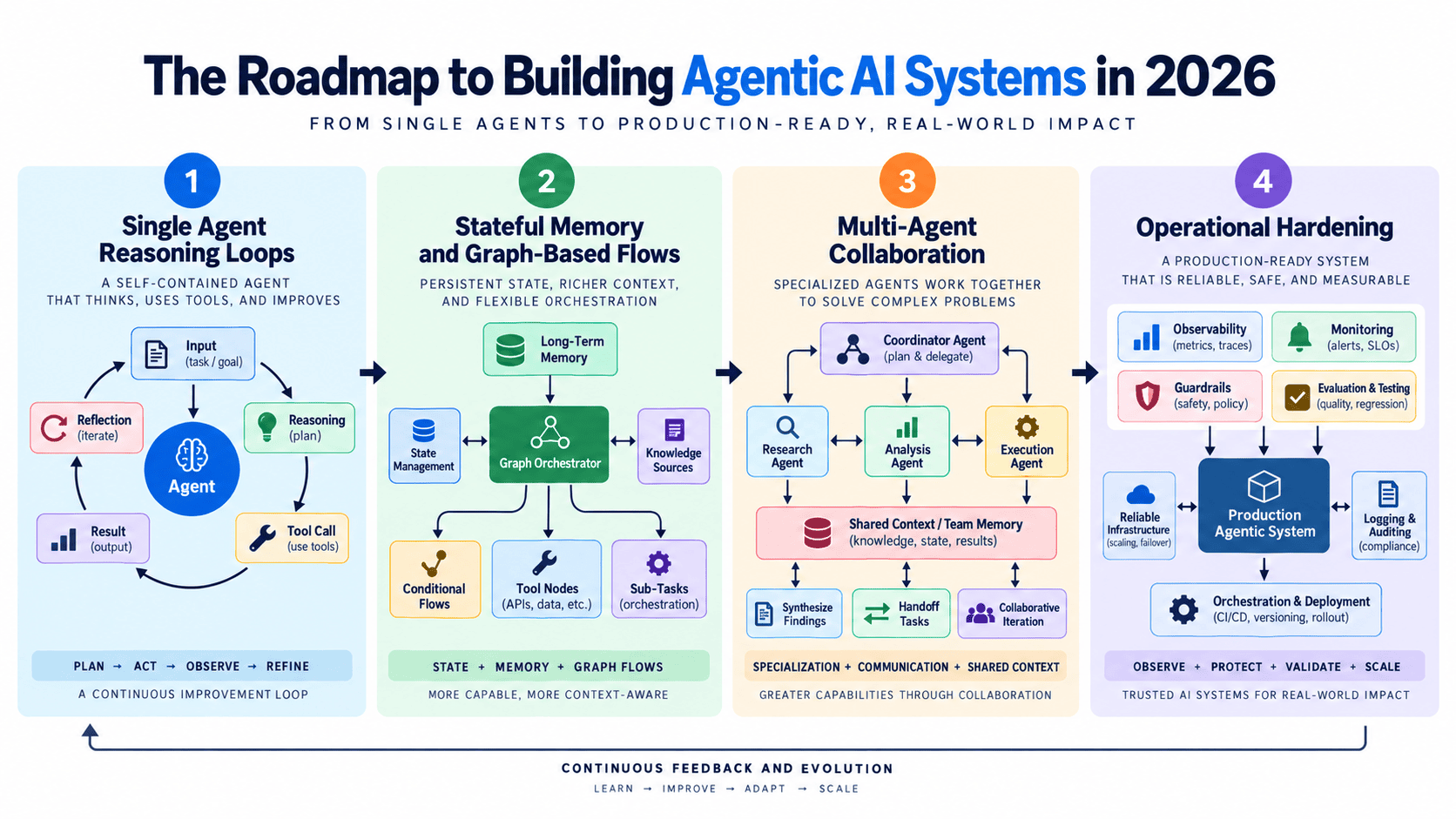
The term "agentic AI" has moved from research papers into production infrastructure faster than most people anticipated. Systems that autonomously plan, use tools, and iterate toward goals are now deployed in code review pipelines, research assistants, customer operations platforms, and internal automation tools at companies of every size.
But building agents that actually work reliably in production is substantially harder than building a convincing demo. The gap between a single-turn chatbot and a multi-step autonomous system involves a different class of engineering challenges: state management, failure recovery, sandboxed execution, and evaluation of multi-step trajectories rather than individual outputs.
This roadmap moves through four levels of increasing system complexity, from understanding individual cognitive architectures to designing, hardening, and observing full multi-agent systems.
Step 1: The Anatomy of an Agent and Cognitive Architectures
Before building systems of agents, you need a precise understanding of how a single agent works. An "agent" in AI refers to a system that perceives its environment, selects actions, executes those actions through tools, and uses the results to inform its next decision. That loop, repeated across many steps, is what separates an agent from a standard language model call.
Several reasoning paradigms govern how agents structure that loop:
- ReAct (Reasoning + Acting) interleaves chain-of-thought reasoning with tool calls, producing a traceable "thought, act, observe" pattern that is both interpretable and effective for many tasks.
- Plan-and-Solve generates a full plan upfront before beginning execution, useful when task structure is predictable.
- Reflection patterns have the model critique its own outputs before committing, catching a class of errors that standard generation misses.
- Tree of Thoughts explores multiple reasoning branches in parallel, evaluating each before selecting the best path forward.
Structured tool interaction is the second core concept. Modern agents interact with tools through function calling protocols, where the model outputs a structured call to a defined function (search, code execution, database query), receives a result, and incorporates it into its next reasoning step. Strict output validation using Pydantic or TypeChat prevents malformed tool calls from cascading into downstream failures.
Dynamic context assembly is the third challenge. Long-running agents consume tokens as they loop. Managing what goes into the context window at each step, what gets summarized, and what gets retrieved from memory rather than retained directly is a practical systems problem that affects both cost and coherence.
from pydantic import BaseModel
from typing import Literal

class SearchToolCall(BaseModel):
    tool: Literal["web_search"]
    query: str
    max_results: int = 5

class CodeToolCall(BaseModel):
    tool: Literal["run_python"]
    code: str
    timeout_seconds: int = 30

# Validate structured tool output before execution
raw_output = '{"tool": "web_search", "query": "2026 AI benchmarks", "max_results": 3}'
import json
call = SearchToolCall(**json.loads(raw_output))
print(call)
Validating tool calls before execution prevents a wide range of runtime failures in long-running agent loops.
Recommended resources: The original ReAct paper ("ReAct: Synergizing Reasoning and Acting in Language Models"); LangChain documentation on agents and tool use; the Pydantic documentation for output validation patterns.
Portfolio exercise: Build a single-agent system that answers multi-hop research questions by combining web search and a calculator tool. Log every reasoning step and tool call to a file.
Step 2: Stateful Memory and Graph-Based Control Flows
A single-loop agent that loses context between tool calls is brittle. The next level of agent design involves giving systems memory that persists across steps, and replacing linear execution chains with flexible graph-based control flows.
Memory in agentic systems comes in three forms:
- Working context is what the agent holds in its active context window during a run. It's fast but expensive and bounded.
- Episodic memory stores past interactions and retrieves relevant ones via vector search, letting agents recall specific prior events without keeping them in context.
- Semantic memory encodes general knowledge in structured form, often as a knowledge graph, enabling reasoning over entities and their relationships.
The shift from chains to graphs matters just as much. Linear chains (step 1 — step 2 — step 3) are straightforward but inflexible. Real tasks branch: a research agent might follow one path if a source is found and a different path if it isn't. LangGraph models these execution flows as directed acyclic graphs (DAGs) or, where iteration is needed, cyclical state machines. AutoGen from Microsoft offers a similar capability with a different ergonomic model.
State persistence is where production agentic systems diverge from prototypes. Checkpointing agent state at every step enables three important capabilities: rollback to a prior state when something goes wrong, resumption of a paused run (critical for long-running tasks or human approval gates), and debugging of branching execution paths after the fact.
from langgraph.graph import StateGraph, END
from typing import TypedDict

class AgentState(TypedDict):
    query: str
    search_results: list
    final_answer: str

def search_node(state: AgentState) -> AgentState:
    # Perform search and return updated state
    results = ["result_1", "result_2"]
    return {**state, "search_results": results}

def answer_node(state: AgentState) -> AgentState:
    answer = f"Based on {len(state['search_results'])} results..."
    return {**state, "final_answer": answer}

graph = StateGraph(AgentState)
graph.add_node("search", search_node)
graph.add_node("answer", answer_node)
graph.add_edge("search", "answer")
graph.add_edge("answer", END)
graph.set_entry_point("search")
This defines a two-node LangGraph state machine with typed state management — the foundational pattern for building more complex agentic flows.
Recommended resources: The LangGraph documentation and conceptual guides; the AutoGen paper and GitHub repository; Building LLM-Powered Applications by Valentina Alto for broader architecture context.
Portfolio exercise: Extend your single-agent research system to use vector-based episodic memory (store past queries and results, retrieve relevant ones for new queries). Benchmark whether memory retrieval improves answer quality on repeated topic areas.
Step 3: Multi-Agent Collaboration and Protocol Design
When a single agent isn't enough, the next step is designing teams of specialized agents that collaborate on tasks too large or complex for one system to handle alone.
Team topology is the first design decision:
- Hierarchical patterns use a supervisor agent to decompose tasks and delegate subtasks to worker agents, then synthesize their outputs. This is the most common production pattern because it's interpretable and easy to debug.
- Debate-and-critique architectures pair a generator agent with a critic agent that reviews and challenges the generator's output, improving quality on tasks where self-critique is insufficient.
- Peer-to-peer arrangements let agents communicate laterally, useful for tasks where parallel exploration across independent agents is valuable (e.g. competitive analysis across multiple markets simultaneously).
Inter-agent communication protocol design is underappreciated but essential. Agents that communicate through unstructured text accumulate errors across handoffs. Defining structured message schemas for task assignments, status updates, and result reporting — along with explicit task handoff contracts — cuts coordination failures significantly.
Conflict resolution becomes necessary when specialized agents produce divergent outputs. A critic agent may reject a coder agent's solution; a research agent may surface evidence that contradicts a planner agent's assumptions. Your system needs defined mechanisms for handling these divergences, whether through voting, re-querying with the conflicting context, or escalating to a human reviewer.
The Model Context Protocol (MCP), introduced by Anthropic, provides a standardized interface for connecting agents to external tools and data sources, and is increasingly being adopted as a cross-vendor standard for agent tool integration.
Recommended resources: The AutoGen paper's section on conversation patterns; the CrewAI documentation for high-level multi-agent orchestration; the MCP specification and ecosystem documentation.
Portfolio exercise: Build a three-agent system (researcher, writer, critic) that produces a structured report on a given topic. Have the critic reject the writer's draft at least once and trace how the system recovers.
Step 4: Operational Hardening, Sandboxing, and Observability
A multi-agent system that works in development but fails unpredictably in production isn't a finished product. This stage covers the engineering practices that make agentic systems reliable, safe, and debuggable at scale.
Runaway loop mitigation is the first operational concern. Agents that lose track of their goal, encounter unexpected tool outputs, or get stuck in self-reinforcing reasoning loops can consume unbounded tokens and time. Circuit breakers (halt execution after N failed steps), recursion depth caps, and dynamic token expenditure ceilings should be built as first-class infrastructure, not bolted on later.
Sandboxed code execution is essential for any agent with code execution capabilities. Allowing an agent to run arbitrary Python on a shared server is a security risk. Isolated execution environments — whether Docker containers, e2b cloud sandboxes, or WebAssembly runtimes — provide the confinement needed to let agents write and run code safely.
Observability is where most early agentic deployments fall short. Evaluating the quality of a multi-step agent trajectory requires more than checking the final output. LangSmith and Arize Phoenix both provide execution graph tracing that records every agent step, tool call, and intermediate state. This makes it possible to identify where in a trajectory an agent went off track — not just whether the final answer was correct.
Trajectory-level evaluation — scoring the efficiency and correctness of the full execution path rather than only the terminal output — is the emerging standard for production agent quality assessment.
from langsmith import traceable

@traceable(name="research_agent_step")
def research_step(query: str, step_number: int) -> dict:
    # Agent step logic here
    result = {"step": step_number, "query": query, "status": "completed"}
    return result

# All calls to research_step are automatically traced in LangSmith
output = research_step("AI safety benchmarks 2026", step_number=1)
Wrapping agent steps with LangSmith's @traceable decorator enables full trajectory tracing with minimal code changes.
Recommended resources: The LangSmith documentation on tracing and evaluation; Arize Phoenix documentation for open-source observability; the e2b documentation for cloud sandbox execution; Reliable Machine Learning by Cathy Chen et al. for broader production systems context.
Portfolio exercise: Take your multi-agent system from Step 3, add LangSmith tracing to every agent step, run 10 test cases, and write a trajectory analysis identifying the most common failure point in the execution graph.
Recommended Learning Resources
- Papers: ReAct (Yao et al., 2022); Reflexion (Shinn et al., 2023); AutoGen (Wu et al., 2023)
- Libraries: LangGraph, LangChain, AutoGen, CrewAI, e2b, LangSmith, Arize Phoenix, Pydantic
- Courses: DeepLearning.AI's agentic AI short courses (free); Hugging Face's Agents course
- Communities: LangChain Discord; the Latent Space podcast; AI Engineer conference talks (available on YouTube)
Final Thoughts
Agentic AI systems represent a real shift in how software behaves: from passive tools that respond to queries, to active systems that pursue goals across extended time horizons. That shift introduces a corresponding increase in engineering responsibility.
The four levels in this roadmap are ordered by complexity, but they're also ordered by what fails first. Agents without structured validation fail on malformed outputs. Agents without state management lose coherence on long tasks. Agent systems without protocol discipline accumulate errors across handoffs. And all agentic systems without observability infrastructure are impossible to debug when things go wrong.
Build each layer deliberately. The investment in hardening at each level compounds directly into reliability at the next.
Vinod Chugani is an AI and data science educator who bridges the gap between emerging AI technologies and practical application for working professionals. His focus areas include agentic AI, machine learning applications, and automation workflows. Through his work as a technical mentor and instructor, Vinod has supported data professionals through skill development and career transitions. He brings analytical expertise from quantitative finance to his hands-on teaching approach. His content emphasizes actionable strategies and frameworks that professionals can apply immediately.