


Bootstrapping Your Data Science Career: A Guide to Self-Learning Pathways
While not easy, bootstrapping your data science career is possible. Here's an overview of the most important skills and resource suggestions for learning them.

Image by Author
It would be great if you had the time and money to just leave everything behind and go to university to learn data science. What if you don’t have it but still want to boost your data science career? The only option is self-learning.
There are many learning resources and of different kinds available. In this article, I’ll focus on four:
- Online courses & bootcamps
- Books
- Blogs
- YouTube videos
How do you make the best of them?
My first advice is to stick to essential skills for data science.
My second advice regarding the self-learning path is to choose the type of learning that suits you best. Whether it is an online course or reading books, it doesn’t really matter as long as you cover the important skills thoroughly; it all depends on your preferences.
My third advice is to ignore my second advice if you can and combine several, if not all, of the resource types I’ll mention in the following sections.
And my fourth advice (I promise you, it’s the last one!) is to demonstrate and practice your skills by doing projects and build a nice portfolio along the way. This is the best way to showcase you know how to use your knowledge in practice.
Essential Data Science Skills
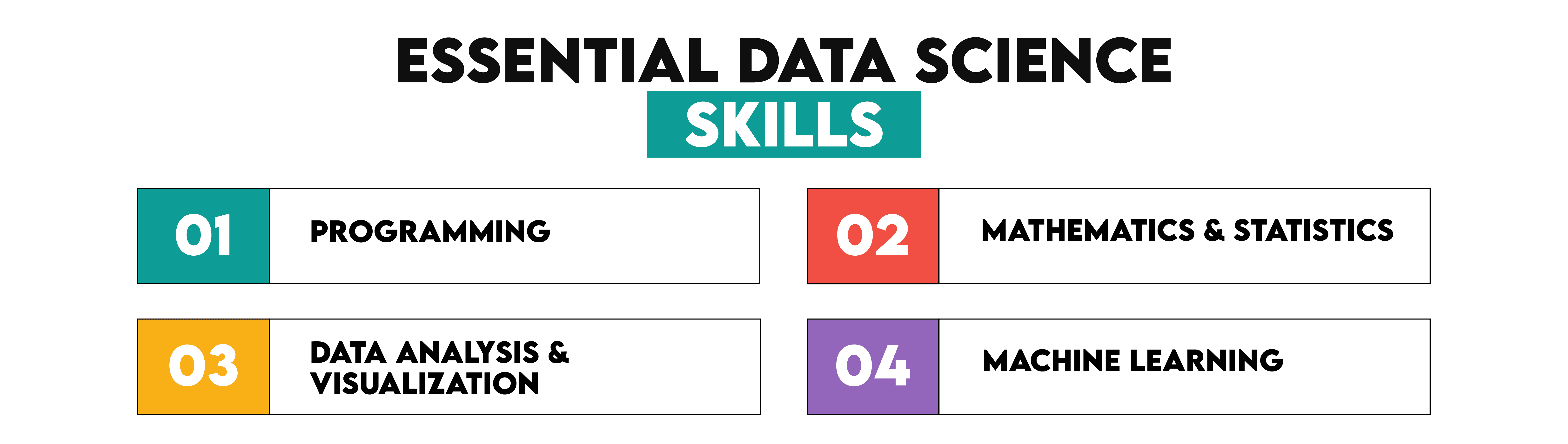
The four skills you must have as a data scientist are programming, mathematics and statistics, data analysis and visualization, and machine learning.
What to Learn and How
1. Learn Programming
Using programming languages is essential for a data science job. This is because all the skills we’ll talk about in the following sections are applied in practice using programming languages. The three languages most commonly used in data science are SQL, Python, and R.
SQL is primarily used for querying and cleaning data.
Python, with its flexibility, has many applications, from data querying and manipulation to analysis, modeling, and data visualization.
R is created for statistical analysis and data visualization.
Resources
Online Courses & Bootcamps
- Python for Everybody Specialization by the University of Michigan on Coursera
- Introduction to Computer Science and Programming Using Python by MIT on edX
- SQL for Data Science by UC Davis on Coursera
- Introduction to R Programming for Data Science by IBM on Coursera
Books
- Python Data Science Handbook: Essential Tools for Working with Data by Jake VanderPlas
- Python Crash Course: A Hands-On, Project-Based Introduction to Programming by Eric Matthes
- Learning SQL: Generate, Manipulate, and Retrieve Data by Alan Beaulieu
- SQL for Data Scientists: A Beginner's Guide for Building Datasets for Analysis by Renee M. P. Teate
- R for Data Science: Import, Tidy, Transform, Visualize, and Model Data by Hadley Wickham, Mine Çetinkaya-Rundel, and Garrett Grolemund
- Practical Data Science with R by Nina Zumel and John Mount
Blogs
YT Videos
- Corey Schafer – Python
- Sentdex – Python
- DataCamp – SQL, Python & R
- freeCodeCamp.org – SQL, Python & R
2. Foundation in Mathematics and Statistics
Data science’s fundamentals are in mathematics and statistics. These two disciplines are essential for anyone wanting to get even close to data science. The crucial topics are linear algebra, calculus, probability theory, descriptive and inferential statistics, regression analysis, and statistical inference.
Resources
Online Courses & Bootcamps
- Mathematics for Machine Learning Specialization by Imperial College London on Coursera
- Probability - The Science of Uncertainty and Data by MIT on edX
- The Data Science Course: Complete Data Science Bootcamp 2024 by 365 Careers on Udemy
Books
- Practical Statistics for Data Scientists: 50 Essential Concepts by Peter Bruce and Andrew Bruce
- Introduction to Probability by Joseph K. Blitzstein and Jessica Hwang
Blogs
YT Videos
3. Data Analysis and Visualization
Data analysis marries your statistical and programming knowledge. It involves exploring and manipulating your data and then analyzing it using fundamental statistical techniques. This is most commonly done in Python (and using libraries such as pandas and NumPy) and R.
The same is true with visualization – it’s not enough to know the principles of data visualization; you must be able to execute it using specialized tools. These are Pyhton’s libraries (Matplotlib, seaborn, Plotly), R libraries (ggplot2), and BI tools such as Tableau, Power BI, or Looker Studio.
Resources
Online Courses & Bootcamps
- Data Analysis with Python by IBM on Coursera
- Analyzing and Visualizing Data with Power BI by Davidson College on edX
- Data Visualization with R by IBM on Coursera
Books
- Python for Data Analysis: Data Wrangling with pandas, NumPy, and Jupyter by Wes McKinney
- Data Visualization: A Practical Introduction by Kieran Healy
Blogs
YT Videos
4. Machine Learning
Your machine learning knowledge should cover concepts essential for data science, such as types of machine learning (supervised, unsupervised, semi-supervised) and the most common algorithms, bias-variance tradeoff, regularization techniques, model evaluation, dimensionality reduction, and feature engineering.
Like data analysis and visualization, it’s not enough to know all this in theory; you need to apply this knowledge using tools. Commonly, it’s again Python with various machine learning libraries, such as scikit-learn, TensorFlow, Keras, and PyTorch.
Resources
Online Courses & Bootcamps
- Machine Learning Specialization by Stanford and DeepLearning.AI on Coursera
- Principles of Machine Learning: Python Edition by Microsoft DAT275x on edX
Books
- Hands-On Machine Learning with Scikit-Learn, Keras, and TensorFlow: Concepts, Tools, and Techniques to Build Intelligent Systems by Aurélien Géron
- Pattern Recognition and Machine Learning by Christopher M. Bishop
Blogs
YT Videos
Bringing Everything Together: Building a Portfolio
As someone who still hasn’t worked in data science, you lack practice, which is why building a portfolio is of extreme importance to you.
A good portfolio is a carefully curated collection of data science projects. Doing projects will help you bring together all the knowledge we talked about. Data science projects can focus on one aspect of data science, but very often, they are end-to-end projects. Such projects will force you to learn every skill data scientist needs and use it in practice on actual data to solve real-world problems.
Here are some resources for finding project ideas and datasets.
Conclusion
While not easy, travelling a data science career path on your own is possible. However, it depends on you giving the structure to your learning and finding learning resources, unlike academic learning.
To help you with this, I outlined four essential data science skills you should focus on, which are programming, mathematics and statistics, data analysis and visualization, and machine learning.
You can use many resources to learn these skills. Start by learning how to become a data scientist, then use some of the resources I gave above to work your way through.
Good luck with bootstrapping your data science career!
Nate Rosidi is a data scientist and in product strategy. He's also an adjunct professor teaching analytics, and is the founder of StrataScratch, a platform helping data scientists prepare for their interviews with real interview questions from top companies. Nate writes on the latest trends in the career market, gives interview advice, shares data science projects, and covers everything SQL.