


High-Performance Data Processing with Polars: A KDnuggets Cheat Sheet
Polars is a DataFrame library written in Rust on the Apache Arrow memory format, and the speed comes less from the language than from the model. The model? Describe your work as expressions, and the Polars query engine plans them out.
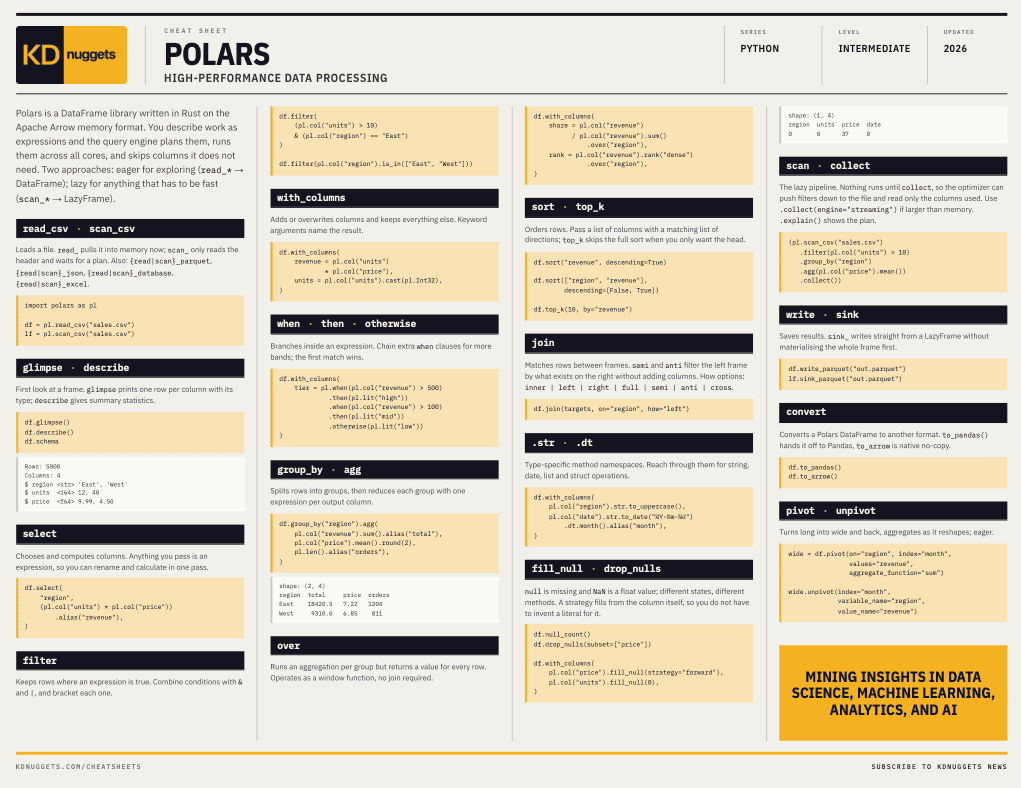
Most people arrive at Polars after a specific kind of frustration: they have a dataset that fits on disk but not in memory, or they try to perform a transformation that runs on one core while the other fifteen sit idle. Polars is a DataFrame library written in Rust on the Apache Arrow memory format, and the speed comes less from the language than from the model. The model? Describe your work as expressions, and the Polars query engine plans them out. It then decides how to execute them, across all available cores, skipping unnecessary columns. The latest KDnuggets cheat sheet gives you all of the foundational functionality needed to make Polars work best for you.
That model is easiest to see in scan_csv and collect. Where read_csv pulls a file into memory immediately, scan_csv reads only the header and waits. Everything you chain after it is a description of intent; nothing executes until collect, which gives the optimizer room to push your filters down to the file itself and read only the columns your pipeline actually uses. For files larger than memory, collect(engine="streaming") processes in chunks rather than giving up.
The second big idea to know from the jump is over. It runs an aggregation per group but returns a value for every row, meaning calculating each region's share of its own total, or ranking within a category, needs no groupby-and-join indeividual treatment. It is a window function that reads like a normal column expression.
There is a small distinction that causes outsized confusion, so let's deal with it right now. In Polars, null means missing and NaN is an actual float value. They are different states with different methods, and expecting them to behave as one thing is a common early stumble.
Beyond those, the cheat sheet covers the full working surface. There is the core verb set of select, filter, and with_columns; grouping and reshaping through group_by, agg, pivot, and unpivot; conditional logic with when/then/otherwise; joins including the semi and anti variants that filter without widening a frame; the .str and .dt namespaces for type-specific operations; and the output side, where sink_parquet writes straight from a lazy frame without materializing it first. There is also to_pandas and to_arrow, because adopting Polars rarely means abandoning everything already built around Pandas.
Download our Polars: High-Permance Data Processing cheat sheet and become quicker and more efficient immediately.